
Implementing an ERP (Enterprise Resource Planning) system is one of the most invasive surgeries a business can undergo. It touches your accounting, inventory, HR, and sales simultaneously.
The software itself is only half the equation. The other half is the team that installs it. Industry data from Gartner and other analysts suggests that roughly 55% to 75% of ERP projects fail to meet their original objectives. These failures rarely happen because the software is bad. They happen because the implementation partner did not understand the business.
If you are looking for an odoo partner in egypt, you are navigating a crowded marketplace. Here is the honest guide to filtering out the salespeople and finding the engineers who can actually deliver.
QUICK DECISION CHECKLIST: Partner Qualification in 10 Questions
Before scheduling a sales call, verify these baseline criteria:
1. Partner is certified in the current or previous Odoo version (verify on Odoo's official partner directory)
2. Partner can provide 2+ references from your industry vertical
3. Partner has local presence within 3 hours travel time of your primary facility
4. Partner's proposal includes a documented implementation methodology (not just a timeline)
5. Partner discusses upgrade strategy during the sales phase (not just installation)
6. Partner's technical team size is at least 30% of their total staff (avoid sales-heavy firms)
7. Partner provides a written Data Migration plan before contract signature
8. Partner's SLA specifies response times for critical system failures (under 4 hours)
9. Partner pushes back on at least one customization request (proves they prioritize your long-term success)
10. Partner's implementation-to-license cost ratio falls between 3x and 5x (anything lower is underestimated)
- Scoring: 8-10 = Proceed with confidence
- 5-7 = Request clarification on gaps
- Below 5 = Disqualify
Understanding Odoo Partner Tiers
Odoo S.A. categorizes its partners into tiers. It is crucial to understand that these tiers are primarily based on sales volume and certified staff count, not necessarily on customer satisfaction or niche expertise.
Differences Between Gold, Silver, and Ready Partners
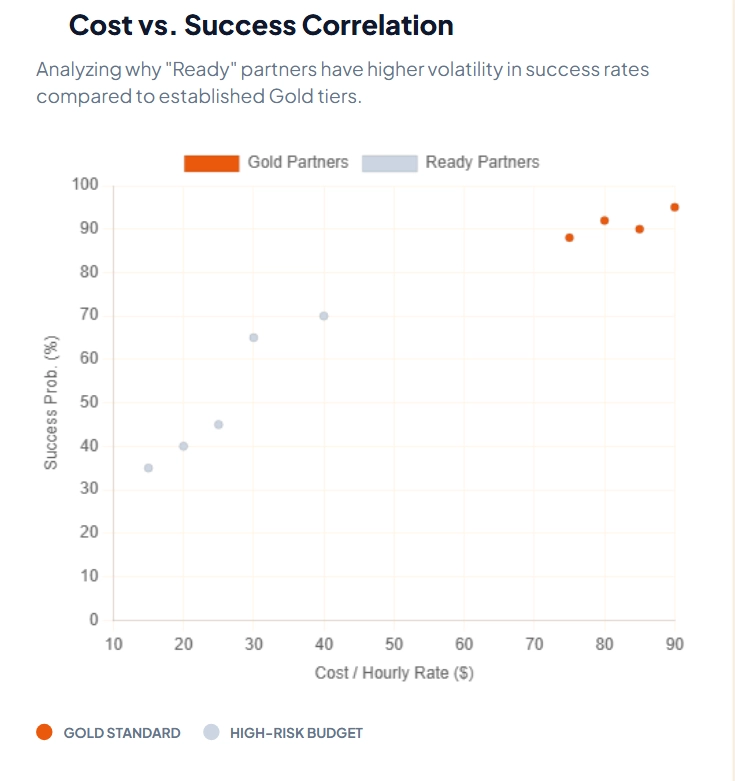
- Gold Partners: These are the heavy hitters. To reach Gold status, an odoo official partner must generate significant annual license revenue, maintain a high number of certified employees, and demonstrate a high customer retention rate (typically above 80%). They have deep resources but often come with higher hourly rates.
- Silver Partners: These firms have proven experience and certified staff but operate at a lower volume than Gold partners. They are often the "sweet spot" for mid-sized businesses, offering experienced talent without the premium price tag of a massive consultancy.
- Ready Partners: An odoo ready partner is effectively a junior partner. They are starting their journey. While they might be talented, they lack the verified track record of Silver or Gold tiers. Hiring them is a higher risk, often balanced by lower costs.
Why Certification Matters for Project Success
Certification is your only objective proof of competence. Odoo updates its software annually (e.g., Odoo 17, Odoo 18). A partner certified in Odoo 13 is functionally obsolete in 2025. You must verify that the team has passed the latest functional and technical exams. This ensures they know the current features and won't bill you to "build" something that is now a standard feature in the core system.
Key Selection Criteria
Do not just search for "best odoo partner" on Google and click the first result. You need to filter by relevance.
Verifying Industry-Specific Experience
ERP logic varies wildly between industries. A partner who excels in Retail (Point of Sale, E-commerce) might be incompetent in Manufacturing (Bill of Materials, Work Centers). Ask for proof of previous projects in your specific sector. If they cannot show you a similar client, you are paying them to learn your industry on your dime.
Checking for Local Presence and Support Teams
Remote support works for minor bug fixes, but for a "Go-Live" week, you want boots on the ground. A local team understands the cultural nuance of how your employees actually work. If the internet goes down in your warehouse, you need a partner who can arrive on-site, not one who is in a timezone six hours away.
Assessing Technical vs. Functional Capabilities
You need a balance.
- Functional Consultants: They understand accounting, supply chain, and workflows. They map your business to Odoo.
- Technical Developers: They write Python code to change how Odoo behaves.
If a partner is too heavy on developers, they will code unnecessarily complex solutions. If they are too heavy on consultants, they won't be able to automate your unique requirements.
Evaluating Data Migration Capabilities
Data migration is the hidden iceberg of ERP implementations. The technical challenge is not moving data from System A to System B. The challenge is transforming inconsistent, duplicate, and corrupted legacy data into clean records that Odoo can process.
The Risk Profile
A manufacturing client once migrated 15 years of purchase orders into Odoo. The legacy system allowed blank vendor fields. Odoo does not. The result: 40,000 purchase orders rejected during import, requiring three weeks of manual data cleanup at $150 per hour.
What to Verify:
Ask the partner for their data cleansing protocol. A competent partner will insist on a Data Profiling phase before migration begins. This phase identifies:
- Duplicate records (multiple customer entries for the same entity)
- Orphaned transactions (sales orders without corresponding customers)
- Invalid formats (dates stored as text, currencies without decimal precision)
The Standard: A professional partner should provide a Migration Runbook that documents field mapping, transformation rules, and rollback procedures. If they promise to "just import everything," you are funding a disaster.
Why Local Expertise is Non-Negotiable
For enterprises operating in regulated markets, a generic global implementation poses significant compliance risks. The regulatory environment requires specific localization for egypt that standard Odoo modules often do not provide out of the box.
Handling E-Invoicing and Tax Compliance
Many governments now mandate real-time integration for electronic invoicing and tax reporting. This is a technical requirement, not a feature preference. Top-tier odoo implementation partners possess pre-built, verified connectors that link Odoo directly to local government portals.
- The Risk: Reliance on manual uploading or unverified third-party middleware exposes the business to severe penalties. You must verify that the partner’s solution supports the specific digital signature requirements and validation protocols enforced by your local tax authority.
Customizing Payroll for Local Labor Laws
Standard Odoo payroll modules are designed primarily for US and European tax structures. They often do not natively accommodate complex local labor regulations, specifically regarding social security calculations, insurance brackets, and tiered income tax structures.
- The Requirement: A qualified partner must demonstrate a localized HR module that automatically calculates these deductions and generates the required statutory reports without manual intervention.
Experience with Right-to-Left (RTL) Implementation
If your business operates in a region requiring Arabic, Hebrew, or Persian languages, the "Right-to-Left" (RTL) alignment often disrupts standard report layouts. A partner with proven regional experience will have a library of front-end fixes to ensure that invoices, purchase orders, and the user interface maintain professional formatting across all languages.
The Vetting Process: Questions to Ask
Vendor qualification requires rigorous due diligence. Do not rely on marketing presentations. You must interrogate the partner’s operational maturity.
Asking for Relevant Case Studies and References
Digital portfolios are often misleading. You require verification of active, live deployments.
- The Approach: Request the contact information of a client in your specific industry who has been live for at least six months.
- The Question: "Can you provide a reference for a project where you handled [Specific Complexity, e.g., Manufacturing Routes]?" If the best odoo partners cannot produce a relevant reference, they are likely using your project as a learning opportunity.
Inquiring About Implementation Methodology
Professional implementations follow a structured lifecycle, typically modeled on Odoo’s "QuickStart" or a modified Agile framework.
- The Red Flag: If a partner cannot produce a documentation roadmap (Business Requirement Document or GAP Analysis), they lack the necessary process discipline.
- The Standard: A competent proposal must outline distinct phases for Analysis, Configuration, Customization, User Acceptance Testing (UAT), and Deployment.
Defining the Scope of Post-Implementation Support
The "Go-Live" date marks the beginning of operational risk, not the end.
- The Contract: You must define the Service Level Agreement (SLA) before signing.
- The Specifics: Does the support contract cover bug fixes only, or does it include functional questions? What is the guaranteed response time for a "System Down" critical error? A standard professional response time for critical issues is under four hours.
Engagement Models and Pricing
Odoo partner pricing structures are often opaque. Understanding the distinction between software costs and service costs is vital to controlling your capital expenditure.
Fixed-Price vs. Time and Material Contracts
Fixed-Price Contracts: The partner quotes a set fee for a defined scope.
- The Reality: This offers budget certainty but introduces risk. If the project complexity exceeds the estimate, the partner is incentivized to cut corners or rush testing to protect their margin.
Time and Material (T&M): You pay for the actual hours worked.
- The Reality: This offers maximum flexibility but risks budget ballooning.
- The Recommendation: A hybrid model is often superior. Use a Fixed-Price model for the standard installation and configuration, and T&M for complex custom development.
Understanding Implementation Fees vs. License Costs
A common misconception is that the implementation cost will match the license cost. This is rarely true.
- License Cost: This is the fee paid to Odoo S.A. for the software rights.
- Implementation Fee: This is the fee paid to the partner for their expertise. For a professional deployment, industry standards suggest the implementation service usually ranges from 3x to 5x the annual license cost. If a quote falls significantly below this ratio, the partner is likely underestimating the required effort.
Ongoing Support and Maintenance
An ERP system is a living operational asset, not a one-time purchase. It requires continuous maintenance to remain secure and efficient.
Service Level Agreements (SLAs) and Response Times
Your contract must specify guaranteed response times. A verbal promise is insufficient.
- Critical Severity: The system is down or a core module (e.g., Invoicing) is non-functional. The standard response time should be under 4 hours.
- High Severity: A feature is broken but workarounds exist. The standard response is 1 business day.
- Low Severity: Cosmetic issues or questions. The standard response is 3 to 5 business days.
Upgrades and Version Migration Services
Odoo releases a new major version annually. Upgrading a heavily customized database is technically complex and expensive. An honest odoo reseller will design your system with minimal code changes to facilitate easier future upgrades. If a partner does not discuss the upgrade path during the sales phase, they are ignoring the long-term total cost of ownership (TCO).
The Continuous Improvement Model
The most valuable partners operate beyond break-fix support. They function as embedded advisors who proactively identify optimization opportunities.
What This Looks Like in Practice:
- Quarterly Business Reviews: The partner analyzes your system usage data and presents findings. Example: "Your warehouse team is using 12 manual steps for goods receipt. Odoo's barcode scanning can reduce this to 3 steps. Estimated time savings: 6 hours per day."
- Feature Adoption Roadmaps: Each Odoo version introduces 200+ new features. A proactive partner will audit your processes and recommend specific features that match your workflows. Most companies use less than 40% of Odoo's capabilities simply because they are unaware they exist.
- Performance Optimization: As your database grows, queries slow down. A technical partner should monitor performance metrics and optimize database indices, archive old records, and tune server configurations before users complain about speed.
The Contract Language: Include a clause requiring bi-annual "System Health Audits" where the partner formally evaluates your configuration, identifies technical debt, and proposes improvements. This transforms the relationship from reactive vendor to strategic partner.
Warning Signs and Red Flags
Partners Without Verified References
If a partner cannot produce a reference from a company of similar size and complexity, they are neffectively practicing on your business.
Over-Promising Customization Instead of Standard Features
This is the most dangerous red flag. A weak partner will agree to every customization request to close the sale. A strong partner will push back.
- The Technical Truth: Every line of custom code represents future technical debt. It costs money to build, money to debug, and money to migrate during upgrades. The most successful implementations utilize at least 90% of Odoo’s standard features.
Common Implementation Failures: Real Scenarios
Understanding how implementations fail is as valuable as knowing how they succeed. These are patterns observed across hundreds of deployments.
Scenario 1: The Scope Creep Catastrophe
The Setup: A retail chain signs a fixed-price contract for "basic Odoo Point of Sale implementation." During configuration, the operations manager requests loyalty points integration. The sales director wants customer purchase history dashboards. The finance team needs custom discount approval workflows.
The Failure: None of these requirements were in the original scope. The partner, locked into a fixed price, either refuses (damaging the relationship) or agrees and rushes the work (introducing bugs). The project timeline extends from 12 weeks to 9 months.
The Prevention: Demand a detailed Scope Document before signing. Any feature not explicitly listed should trigger a formal Change Request process with revised timelines and costs.
Scenario 2: The Customization Trap
The Setup: A distribution company insists their "unique" pricing logic requires custom code. The partner, eager to close the deal, agrees to build it. Six months post-launch, Odoo releases version 18 with a native pricing rules engine that matches the custom solution exactly.
The Failure: The custom code now blocks the upgrade path. The company must either pay to rewrite the custom logic or remain on an obsolete version, missing security patches and new features.
The Prevention: Before approving any customization, ask: "Can this be achieved with standard features in the next two Odoo versions?" A strong partner will challenge your assumptions and protect you from yourself.
Scenario 3: The Training Gap
The Setup: Implementation proceeds smoothly. The system goes live. Within three weeks, users revert to Excel spreadsheets and manual processes because "Odoo is too complicated."
The Failure: The partner provided a single two-hour training session for 40 employees. No role-based training materials. No hands-on practice environment. No post-launch support for user questions.
The Prevention: Require a Training Plan as part of the proposal. Effective training includes: role-specific sessions (warehouse staff need different training than accountants), a sandbox environment for practice, and a 30-day post-launch "office hours" period for questions.
read more about: odoo in egypt
Conclusion
Selecting an implementation team is a strategic decision that outweighs the software selection itself. A mediocre software package implemented by a brilliant team will succeed, but a world-class system implemented by an incompetent team will fail.
By focusing on industry-specific experience, verifying local compliance capabilities, and demanding transparent odoo partner pricing, you mitigate the risks associated with digital transformation. The goal is not just to install Odoo but to build a scalable infrastructure that supports your business for the next decade.