Can you pull last month's revenue by customer in under 5 minutes? What about real-time inventory across your warehouses? If you're still wrestling with disconnected spreadsheets and manual reports, you're not alone and there's a better way.
A Direct Look at Odoo ERP
Does your team log into one system for accounting, another for inventory, and use Excel for everything in between?
That’s the disconnected-systems problem. When your sales team enters an order, does your warehouse know immediately? Or does it kick off a chain of emails, exports, and manual data entry?
odoo system egypt replaces that chaos. It's a single, integrated platform where data is entered once and automatically updates everywhere.
Here’s what that actually means:
- Your Current Workflow: A sales order triggers manual updates emails to the warehouse, re-entry into accounting, and spreadsheet exports for reports.
- With Odoo: Sales enters the order once. That’s it. Everything else is automatic.
Do this quick math: How many orders do you process monthly?
Now, estimate the minutes spent shuffling data for each one (10-15 minutes is common). Multiply those numbers. That’s how much time your team spends on work a single system could automate.
Understanding Odoo ERP and Its Importance for Egyptian Companies
It usually comes down to three realities:
- Cost: Traditional ERPs (like SAP or Oracle) often have implementation costs starting at $200K+. That’s not feasible for most growing SMEs. Odoo’s modular model is built for a much more accessible budget.
- Flexibility: You don't buy the whole system at once. Start with Accounting and Sales. Add Inventory next quarter. This "pay-as-you-grow" approach prevents you from overspending on features you don't need yet.
- Local Expertise: A growing network of certified Odoo partners in Egypt understands local tax laws and business norms. You get a system adapted for your market, not a generic one you have to force-fit.
Where Does Your Company Fall on the Curve?
- Under 20 employees: Excel probably still works (for now).
- 20-50 employees: You’re feeling the pain of manual processes.
- 50-100+ employees: You are past ready for an integrated system.
Let's be direct. Your current system is probably an "Excel empire" where one wrong formula creates chaos, or basic accounting software that doesn't talk to your inventory. The common thread is always disconnected data and the manual work required to bridge the gaps.
Odoo connects it all. One database, with all odoo modules being optional.
What if you could see your entire business cash flow, sales, and inventory on a single screen, right now? That’s the goal.
Core Modules of Odoo ERP for Local Businesses
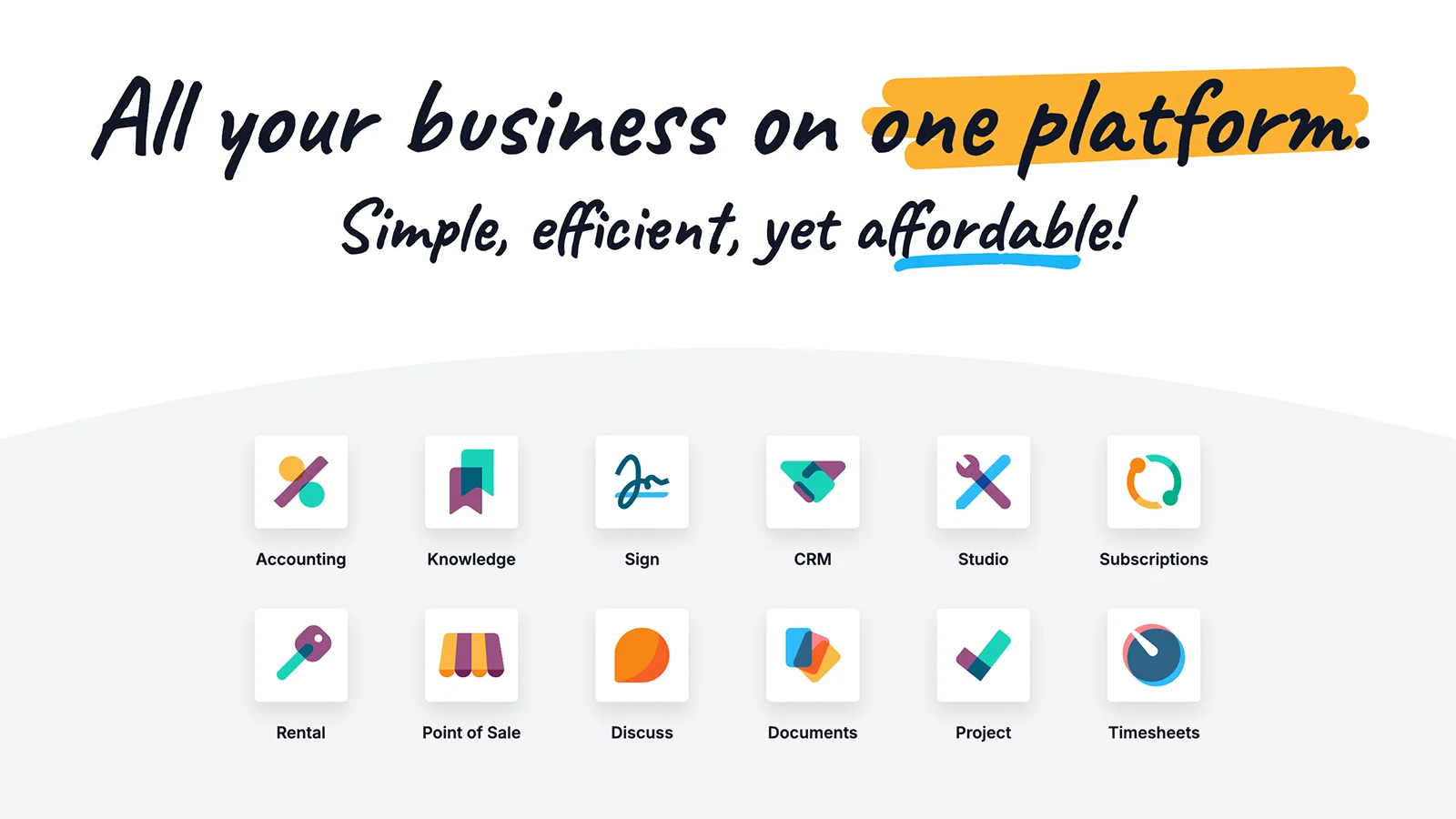
Which module solves your biggest headache?
- Finance: For Egyptian tax compliance, multi-currency, and real-time cash flow.
- Sales: To get rid of messy spreadsheets and build a reliable sales pipeline.
- Inventory: To stop stock-outs and get inventory numbers you can actually trust.
- HR & Payroll: To automate leave requests, attendance, and expense claims.
- Manufacturing: To replace paper work orders with a real-time view of production.
- E-commerce & Services: To connect your online store or service desk directly to your back office.
Finance & Accounting Management Tailored for Egypt
Can your current system handle Egyptian tax compliance automatically? What about generating reports that match what the ETA (Egyptian Tax Authority) expects?
Odoo's accounting module handles the basics you'd expect general ledger, accounts payable, receivables but here's what matters for Egyptian businesses:
- Tax & E-Invoicing Compliance: The system is configured for official Egyptian e-invoicing (ETA), VAT requirements, and local reporting formats.
- Multi-Currency Support: If you deal with foreign suppliers or customers, Odoo handles exchange rate updates and currency conversions in real time. No more manual tracking.
- Arabic & English Interface: Your Arabic-speaking finance team and English-speaking management can use the same system in their preferred language. Data enters once, displays in both.
- Real-Time Cash Flow: How long does it take you to answer, "What's our cash position for the next 30 days?" With Odoo, you're looking at a dashboard, not building a spreadsheet.
Let's do the math: If manual invoice processing takes you 10 minutes per transaction and you process 300 invoices monthly, that's 50 hours of work. You can calculate your own numbers, but the time cost of manual entry is real.
Sales and Customer Relationship Management (CRM)
How many spreadsheets does your sales team maintain? How do you know which deals are actually going to close this quarter?
Odoo CRM tracks your entire sales pipeline in one place. When a lead comes in, it's logged and assigned. As the deal progresses through stages you define, the system reminds reps to follow up. When it closes, it automatically creates a sales order.
What changes for your business:
- Before: The sales manager chases reps for their forecasts, consolidates spreadsheets, and spends a meeting figuring out what’s real.
- After: The sales manager opens a single dashboard. Five-minute forecast instead of a three-hour meeting.
Common question: "Will my sales team actually use this?"
Honest answer: They'll resist at first. Most sales teams do. The trick is starting with something that makes their life easier immediately, like automated follow-up reminders. Once they see the benefit, adoption improves.
Inventory, Supply Chain, and Warehouse Control
When was the last time you had conflicting inventory numbers between your warehouse and your accounting system? Or worse, promised a customer something you didn't actually have in stock?
Odoo connects physical movement to system records in real time.
- Automatic Reordering: Set minimum stock levels. The system automatically generates purchase orders when inventory drops, so you’re not manually checking levels daily.
- Lot & Serial Number Tracking: For businesses needing traceability (food, electronics), you can track products from receipt through delivery.
- Barcode Scanning: Your warehouse team scans items in and out. The system updates inventory, costs, and availability instantly. No manual entry.
The real benefit: When your sales team looks at product availability, they're seeing actual warehouse stock, not week-old numbers from a spreadsheet.
Human Resources and Payroll Solutions
How long does payroll take you each month? How many manual steps are between time tracking and salary payment?
Odoo HR handles the full employee lifecycle, but here's what's key for local businesses:
- Leave Management for Egypt: Annual leave, sick leave, and other categories are configured to match Egyptian labor law. Employees request time off through the system; managers approve with one click.
- Attendance & Timesheets: Employees clock in and out, feeding data directly into payroll calculations for hours worked, overtime, and late arrivals.
- Expense Management: Employees submit expenses with a photo of the receipt. It flows from manager approval to accounting for reimbursement. No more paper forms.
A note on payroll: The module can be configured for Egyptian salary structures, social insurance, and taxes. However, payroll is complex. Some businesses choose to integrate Odoo with a proven payroll provider to minimize risk, while others use the built-in module once it's properly configured by their implementation partner.
Manufacturing & Production Management for SMEs
Does your manufacturing floor operate on paper work orders? How do you track production costs accurately?
Odoo's manufacturing module handles:
- Bill of Materials (BOMs): Define the exact raw materials, labor, and overhead for each product.
- Work Orders: When production starts, the system generates work orders, tracks progress, and consumes materials from inventory automatically.
- Real-Time Costing: Know your actual production costs as they happen, not three weeks later.
For many smaller manufacturers, this visibility is a game-changer. You find out about production delays before the customer calls asking where their order is.
E-Commerce, Website Management, and Digital Marketing Tools
Are you running an e-commerce store on a separate platform that doesn't talk to your inventory or accounting?
Odoo includes a full website builder and e-commerce platform. When a customer places an order online, it flows directly into your back office. Inventory is reserved, the warehouse gets the pick list, and accounting books the revenue all connected. The platform also includes tools for email marketing, live chat, and basic SEO.
Here's the trade-off: If you need the absolute most advanced e-commerce features, a specialized platform like Shopify has more depth. But if seamless integration with inventory and accounting matters more, Odoo's unified approach is incredibly efficient.
Service Management and Customer Support Modules
How do you track customer support issues, field service jobs, or billable project hours?
Odoo's service modules help you manage the customer experience after the sale.
- Helpdesk: Customer submits a support request. The system creates a ticket, assigns it, and tracks it through resolution while keeping the customer updated.
- Field Service: If you have technicians visiting customer sites, you can schedule appointments, manage parts used, and invoice for the service all in one place.
- Project Management & Timesheets: For service businesses delivering projects (like consulting or marketing), you can track tasks, log billable hours, and monitor project profitability automatically.
Local Benefits of Odoo ERP for Egyptian SMEs
When you're choosing a management system in Egypt, features are only part of the story. You need software that handles local compliance, affordability, and the specific operational realities of the market. odoo erp egypt based partners is becoming the top choice because it directly addresses these challenges. Here’s a direct look at the local advantages.
Local Compliance with Tax and Labor Laws
Are you manually preparing reports for the Egyptian Tax Authority (ETA) or tracking leave policies in a spreadsheet? This is a significant compliance risk.
Odoo is designed to be configured for local regulations. This means:
- Tax & E-Invoicing: The system can be set up for official Egyptian e-invoicing compliance with the ETA, along with handling VAT requirements and local withholding tax calculations.
- Labor Law: The HR module can be configured to manage leave policies (annual, sick, emergency) according to Egyptian labor law, automating accruals and deductions.
This isn't just a convenience; it's about reducing the risk of costly errors and ensuring your reporting aligns with government standards from day one.
Flexible, Scalable Solutions for Different Industries
Most traditional ERP systems force you to buy a massive, one-size-fits-all package. Odoo’s approach is the opposite.
You start with only the modules you need right now. A typical starting point for an SME is Accounting, Sales, and Inventory. Next year, as you grow, you can add Manufacturing or E-commerce. This modular approach means you aren't paying for features you won't use for two years.
Whether you are in distribution, light manufacturing, retail, or professional services, you can build the system that fits your business instead of changing your business to fit the software.
Cost-Effective Licensing and Subscription Options
Let’s be direct about the cost. Traditional ERP implementations from vendors like SAP or Oracle can start at $200K+ and go up from there a price that puts them out of reach for most Egyptian SMEs.
Odoo's model is fundamentally different. You pay a subscription based on the number of users and the specific apps you use. This makes the initial investment significantly lower and more predictable.
Here's the simple way to see if it's worth it for you:
- Calculate the annual cost of your wasted time. (Hours spent on manual data entry, fixing errors, and reconciling spreadsheets × average employee cost).
- Compare that number to the annual cost of an Odoo subscription.
If that "disconnected systems tax" is higher than the Odoo subscription, the decision becomes straightforward.
Access to Local Implementation Partners and Support
A great system configured badly is a useless system. One of the most significant advantages in Egypt today is the growing network of certified Odoo implementation partners.
Having a local partner means:
- They understand the context: They know the local business culture and regulatory nuances beyond what's written in law.
- On-the-ground support: They can provide training to your team in Arabic and are in your time zone when issues arise.
- Proper configuration: They are responsible for setting up the system correctly for things like ETA e-invoicing and local payroll rules.
This local expertise dramatically reduces implementation risk and ensures the software actually works for your specific business.
Streamlined Reporting and Centralized Operations
What's the root cause of most operational headaches? Data living in different, disconnected places.
Odoo solves this by using a single, centralized database for everything.
- Before Odoo: Month-end closing means chasing departments for their spreadsheets, manually consolidating data, and spending days finding and fixing discrepancies.
- After Odoo: The data is already unified. Generating financial reports takes minutes, not days.
Think about your sales forecast. Instead of a three-hour meeting to consolidate spreadsheets from every sales rep, the sales manager can open a single, real-time dashboard. When sales makes a sale, inventory sees it, accounting sees it, and management sees it.
What if every decision-maker in your company was working from the same, live data? That’s the operational change we’re talking about.
Planning Your Odoo ERP Implementation Roadmap
Planning Your Odoo ERP Implementation Roadmap
Ever seen an ERP rollout fail? It's usually not the software's fault. It's a flawed plan. Companies try to do everything at once.
A phased approach is slower, safer, and actually works. Here’s a 4-step plan.
Phase 1: Assessing Business Needs and Processes
Before you look at Odoo's features, look at your own mess. Where's the biggest fire?
- Is it inventory counts that are always wrong?
- Month-end closing that takes 3+ days?
- Your sales team re-entering data 5 times?
Pick one of those. Now, map the current process.
Use the "Before/After" Technique:
- Before: The current manual workflow involves multiple handoffs:
- Sales gets an order.
- Sales Emails the warehouse.
- Warehouse manually checks a spreadsheet.
- Someone creates the invoice manually.
- Accounting re-enters the data into their system. (That's 5+ manual steps).
- After (with Odoo): Sales enters the order once. Everything else updates. (That's 1 step).
That's your goal. You've just found your starting point.
Phase 2: Launching a Pilot Program
Don't try to switch your whole company at once. It's a recipe for chaos.
Instead, pick one department and one process. Have them run Odoo alongside your old system for a month or two.
Yes, this is double the work for them. But it's also your insurance policy. You'll find all the bugs and training gaps on a small scale. It's much better to have 3 people in purchasing confused for a week than to have 30 salespeople unable to send invoices.
The Go/No-Go Rule: Don't move to Phase 3 until the pilot team is actually faster in Odoo than the old way.
Phase 3: Gradual Rollout Across Teams
Once your pilot works, roll out gradually. Follow the data:
- Start with Sales.
- Next, add Inventory/Warehouse (which feeds from Sales).
- Then, add Accounting (which feeds from Invoicing).
Give each team a few weeks to stabilize before adding the next one.
Heads-up: You will hear this: "The old way was faster!"
It's not true. The old way was just familiar. Familiar feels fast; new feels slow. Trust the clock, not the feeling. Your team will be faster by week 3.
Phase 4: Optimization and Workflow Automation
You can't automate a broken process. You'll just get bad results, faster.
After your team is stable, then you optimize. This is the real ROI.
How to find what to automate? Ask your team: "What do you do every day that's the exact same boring clicks?"
Good candidates:
- Automatic reorder rules for low stock.
- Auto-generating daily sales reports.
- Invoice reminder emails for overdue payments.
Make this a quarterly habit. Ask "What can we automate next?" That's how you go from just using Odoo to profiting from it.
What Does Odoo Actually Cost? (An Honest Look for Egypt)
Your first quote is almost never the final price. Plan for the real cost to be 20-40% higher.
Here's the breakdown:
1. Licensing & Hosting
- Community: "Free," but you need your own technical staff to manage it.
- Enterprise: What most businesses need. Expect $20-$30 USD per user/month. A 20-person team is ~$400-$600/month. (Tip: Not everyone needs a full license).
2. Implementation & Customization
- This is the budget-killer. Odoo handles ~70% of needs out-of-the-box. Customizing the last 30% is the expensive part.
- Typical implementation for an Egyptian SME: EGP 50,000 to EGP 200,000+.
- Pro-tip: Before you pay to customize, ask: "Can we just change our process to match Odoo's standard workflow?" It's usually a better process anyway.
3. Training & "The Dip"
- Budget for training: Figure EGP 5,000 - EGP 15,000 per day for an external trainer.
- Don't forget "The Productivity Dip." Your team will be 20-30% slower for the first month. This is a real, hidden cost. Plan for it.
So... Is It Worth It? (How to Calculate Your ROI)
Combining your two ROI sections is the best move for both SEO (avoiding repetition) and user trust. You want to move from a "vague estimate" to a concrete, local business case.
Here is exactly how to merge and upgrade these sections:
What Does Odoo Actually Cost? (An Honest Look for Egypt)
Before calculating your return, you need an accurate view of the investment. For an Egyptian SME in 2025, plan for these three cost pillars:
Licensing: Odoo Enterprise typically costs $7–$10 USD per user/month. (Tip: Odoo often offers a "One App Free" plan if you only need Accounting for ETA compliance).
Implementation: A standard setup in Egypt ranges from 50,000 EGP to 250,000+ EGP depending on your need for custom ETA integrations or manufacturing workflows.
The "Productivity Dip": Budget for a 20% drop in speed during the first 30 days. This is the hidden cost of "learning the new way."
Measuring Your ROI: The "Manual Work Tax"
Odoo usually pays for itself in 12–24 months, but you don't have to guess. Use this 2025 formula to calculate your "Manual Work Tax" the money you are losing every year to inefficient processes.
The 3-Step Math:
Calculate Wasted Hours: How many hours per week does your team spend on manual data entry, fixing Excel errors, or reconciling warehouse stock with sales? (Average SME: 15–20 hours/week).
Apply Local Labor Costs: Use the 2025 Egyptian private sector average or your specific payroll data.
Note: As of March 2025, the minimum wage is 7,000 EGP/month, but for skilled admin/finance staff, the hourly cost is significantly higher.
The Formula: (Weekly Wasted Hours) x (Hourly Rate) x 52 weeks = Your Annual Manual Work Tax.
Real-World Example: If your finance team spends 10 hours a week fixing invoice errors at a cost of 150 EGP/hour, you are losing 78,000 EGP every year on just one process.
Tangible vs. Intangible Gains
Tangible: 50-70% reduction in manual data entry, lower inventory carrying costs, and zero fines from the ETA due to automated e-invoicing.
Intangible: Faster decision-making, better employee morale (no one likes "boring" data entry), and a professional image for your customers.
Budgeting for Odoo ERP in Egypt
Let's talk money. The initial quote you get will often be underestimated. Not because vendors lie, but because the first number rarely includes everything. Plan for actual costs to run 20 to 40% higher.
Software Licensing and Hosting Expenses
Odoo comes in two versions: Community (free, open-source) and Enterprise (paid, with support and extra features). Community works if you have technical resources in-house. Most businesses don't, which means Enterprise.
When calculating Odoo Egypt pricing, keep in mind that Enterprise licensing typically runs between $13.60 to $20 USD per user per month on Odoo's official cloud platform. For Egyptian SMEs, expect licensing and cloud hosting combined costs roughly $20 to $30 per user monthly (local providers may have different pricing). A 20-person team would cost about $400 to $600 monthly.
Quick tip: Not everyone needs a full license. Your warehouse manager entering data? Yes. Your CEO checking reports occasionally? Probably not. Portal or internal user licenses may suffice.
Customization and Implementation Costs
This is where budgets explode.
Out-of-the-box Odoo handles about 70% of what most businesses need. That last 30%? Customization. And it’s expensive.
Implementation for Egyptian SMEs typically ranges from EGP 50,000 to EGP 200,000+ depending on complexity. A straightforward setup with 2 to 3 modules sits at the lower end. Heavy customization pushes you higher.
Before customizing anything, ask: "Can we change our process to match the standard Odoo workflow instead?" Often, the standard way is better than your current process. You're just attached to "how we've always done it."
Training and Change Management Investment
Budget for real training. Figure 2 to 3 days per department.
For a 30-person company with 4 departments, that’s 8 to 12 training days. External trainers typically cost EGP 5,000 to EGP 15,000 per day.
What companies forget: the productivity dip. Expect productivity to drop 20 to 30% for the first month after go-live. Your team is learning. They're slower. This is normal, but it has a cost.
Long-Term Savings and Return on Investment
If implemented properly, Odoo typically pays for itself within 12 to 24 months for SMEs.
Local Benefits of Odoo ERP for Egyptian SMEs
Compliance with Egyptian Labor and Financial Regulations
Egyptian laws are complex, but Odoo's localization handles VAT, payroll, and the Egyptian chart of accounts right out of the box. This is key because it means the system generates reports in the specific formats required by local tax authorities, saving your accounting team massive manual reformatting time.
Arabic and English Language Support
Odoo supports both Arabic and English natively. Users can switch interfaces, and you can generate invoices and reports in either language for local suppliers or international clients. Crucially, the interface fully supports right-to-left Arabic text without breaking formatting.
Faster Decision-Making Through Centralized Data
This is about speed and confidence. Instead of waiting days for reports, you pull real-time data on inventory, cash position, or aging receivables with one click. This instant data access is what lets you make smarter decisions about accepting large orders or managing cash flow without relying on outdated numbers.
Automating Routine Tasks to Boost Productivity
The real value is elimination, not speed. Odoo eliminates repetitive administrative tasks like manually reconciling data, re-entering invoices, or emailing status updates. Your team stops being data processors and starts focusing on actual productive work. That's the engine of long-term
Common Challenges for Egyptian SMEs and How Odoo Helps
Managing Costs Without Overspending
The biggest cost mistake: buying all the modules upfront.
Start with 2 to 3 core modules. Get those working well. Add more later. You don't need CRM, inventory, accounting, HR, project management, and e-commerce all on day one.
Typical smart starting point: Accounting + Inventory, or Sales + CRM. Add modules as you stabilize.
Adapting the System to Business-Specific Needs
Every business thinks they're unique. Most aren't. Before requesting customization, ask your implementation partner: "How do other companies in our industry handle this?" Often there's a standard approach that works fine once you understand it.
That said, some customization is genuinely necessary. Work with partners who can modify Odoo without breaking it. Bad customization makes future updates nearly impossible.
Lack of In-House ERP Expertise
Most Egyptian SMEs don't have IT departments. That's fine.
Cloud-hosted Odoo means you're not managing servers. Partnering with a local certified provider means you have support when things break. Training your team properly means they can handle day-to-day operations without technical expertise.
What you do need: one person internally who becomes your "Odoo champion." Not a technical expert, just someone who learns the system well and becomes the go-to resource for basic questions.
Ensuring Smooth Data Migration and Staff Training
Data migration breaks more implementations than technical failures.
Your legacy data is messy. Duplicate customer records, inconsistent product codes, incomplete transaction history. Don't migrate the mess. Clean it first, then migrate.
Typical approach: migrate only active customers and current inventory. Archive the rest. You can always reference old systems for historical data while keeping your new system clean.
For training, hands-on beats presentations every time. Let people practice with real data in a test environment before go-live.
ERP Egypt: Complete Guide to Odoo Implementation for SMEs
Sales has one set of numbers. Accounting has another. Your warehouse works off last week’s spreadsheet.
This isn’t a people problem it’s a disconnected systems problem.
Count how many apply to you:
□ You enter the same data in multiple places
□ Month-end closing takes more than 3 days
□ Different departments give different numbers for the same metric
□ You can’t get real-time reports without calling three people
Three or more? This guide covers how Odoo ERP works for Egyptian SMEs, what it costs, and whether it's right for your business.
Understanding the Real Cost of Odoo ERP in Egypt
Let’s talk money first.
“What is Odoo in Egypt price?” depends on what odoo solutions you need, how you configure it, and who implements it. Here's what actually determines your investment:
Software Licensing and Hosting Expenses
Odoo operates on a per-user, per-month subscription model. Your total licensing cost scales with team size 10 users cost significantly less than 50.
The Community Edition (open-source) is free for the software itself, but you'll still pay for hosting, customization, and support. Most Egyptian SMEs end up with ongoing costs once you factor in necessary customizations and local hosting.
Local Egyptian hosting providers are often preferred for speed, compliance, and data sovereignty. Costs vary depending on user count, storage, and service levels.
Reality check: Licensing fees are just the starting point.
Customization and Implementation Costs
Standard odoo application covers about 70-80% of typical business needs. The remaining 20-30% requires customization.
Typical needs for Egyptian businesses include:
- Arabic invoice templates compliant with Egyptian tax authorities
- Integration with existing POS or payment systems
- Custom reports for local financial compliance
- Industry-specific workflows
Implementation scope largely determines cost:
- Basic: 2-3 modules, minimal customization lower cost, quicker deployment
- Standard: 5-7 modules, moderate customization mid-range cost, most common for SMEs
- Complex: 10+ modules, heavy customization higher cost, enterprise-level needs
Timeline: Add roughly 30% more time than your provider’s initial estimate. For example, if quoted 8 weeks, plan on about 11 weeks. Data migration almost always takes longer than expected.
Training and Change Management Investment
Your team has done things the same way for years. New system = new habits = resistance.
Budget for:
- Initial training: 2-3 days per department
- First 3 months support: critical adoption period
- Arabic documentation tailored to your setup
The hidden cost? Expect a 20-30% productivity dip during the first month while your team adjusts. Not permanent just a learning curve.
Long-Term Savings and Return on Investment
Here's how to calculate potential ROI:
Count hours your team spends on:
- Manual data entry and re-entry
- Reconciling conflicting numbers between systems
- Generating reports manually
- Month-end closing
- Inventory counts and corrections
Multiply by true hourly cost (salary + overhead) to get your annual total. Compare this figure to your total Odoo investment (licensing, implementation, training).
Typical payback period for Egyptian SMEs is 12-24 months. Common improvements include month-end closing dropping from 7-10 days to 2-3 days and report generation from hours to minutes.
Your results will vary, but if manual processes are costing more than the ERP investment, the business case is solid.
Common Challenges for Egyptian SMEs and How Odoo Helps
Every Egyptian SME faces similar hurdles when considering ERP. Here’s how Odoo addresses them:
Managing Costs Without Overspending
Start small. You don’t need all 30+ Odoo modules on day one. especially when you get odoo for small businesses in egypt
Most Egyptian SMEs begin with 2 to 4 core modules:
- Accounting
- Inventory
- Sales or CRM
- One industry-specific module
Add more as you grow and as ROI from the initial modules becomes clear. This phased approach keeps upfront costs manageable and gives your team time to adjust between rollouts.
Adapting the System to Business-Specific Needs
Odoo’s open-source foundation means customization is possible without rebuilding from scratch.
Need specific approval workflows? Custom invoice formats? Integration with local suppliers’ systems? All achievable.
The key: document your actual requirements before implementation. “We want everything customized” leads to scope creep and blown budgets. “We need these three specific workflows” keeps projects on track.
Lack of In-House ERP Expertise
Most Egyptian SMEs don’t have dedicated IT teams. That’s normal.
Your options:
- Managed service: Provider handles technical maintenance, you focus on business processes
- Train internal champion: One tech-savvy employee becomes your Odoo expert
- Hybrid approach: Partner handles complex issues, you manage daily operations
Which works best depends on your team size and technical comfort level. Companies under 50 employees typically prefer managed services for ease and reliability.
Ensuring Smooth Data Migration and Staff Training
Data migration fails when you try to move everything at once.
Better approach:
- Clean data before migration (remove duplicates, fix errors)
- Migrate in phases (start with master data, then transactions)
- Run parallel systems for 2-4 weeks during transition
- Train department by department, not everyone simultaneously
Your team will resist change. Expect it. Plan for it. The employees most resistant initially often become the strongest advocates once they see time savings firsthand.
Partnering With a Certified Odoo Provider in Egypt
Implementation makes or breaks your ERP investment.
Advantages of Working With Local ERP Partner
Local Egyptian odoo partner understand challenges international vendors miss:
- Egyptian tax and compliance requirements
- Arabic-speaking support during your business hours
- Local business practices and workflows
- Experience with Egyptian payment systems and integrations
Time zones, language barriers, and lack of local regulatory knowledge make international providers harder to work with.
What to Expect During Implementation
Realistic timeline: 2-6 months depending on complexity.
Key phases:
- Discovery (1-2 weeks): Map processes, define requirements
- Configuration (2-6 weeks): Set up modules, customize workflows
- Data Migration (1-3 weeks): Clean and transfer data
- Testing & Training (2-3 weeks): Fix issues, train team
- Go-Live (1 week): Switch with support on standby
Expect bumps in weeks 2-4 after go-live. Good providers stick with you through this period.
Choosing the Right Partner for Your Business
Look for certified Odoo partners with for the best odoo erp solutions:
- Proven Egyptian implementations
- Arabic-speaking support
- Clear pricing (no hidden costs)
- Post-implementation support plans
2B Solutions offers certified Odoo implementation for Egyptian businesses, with local expertise in customization, Arabic support, and industry-specific configurations.
Additional Resources and Insights
Cybersecurity Measures for ERP Systems
Your ERP holds everything: financial data, customer info, employee records.
Quick security check:
- Can every employee see all financial data? That's a problem.
- Are backups stored only on-site? One fire ends your business.
- Who handles security updates? "Nobody" means you're vulnerable.
Essential minimums: role-based access, two-factor authentication for admins, daily off-site backups, and automatic security patches. Cloud hosting handles updates automatically; on-premise requires technical staff.
Comparing Odoo, SAP, and Other ERP Solutions
Simple decision framework:
500+ employees and multi-national operations? Consider SAP
ERP budget under $100K? SAP won't fit
Need phased implementation? Odoo's modular approach wins
Want 2-6 month deployment? Odoo; SAP takes 6-12+ months
For Egyptian SMEs (10-200 employees), Odoo offers better cost-to-functionality ratio.
Frequently Asked Questions
What is Odoo in Egypt price?
odoo system pricing depends on your team size, selected modules, and complexity of customization. Licensing runs on a per-user, per-month basis. Small teams with basic implementation usually invest less, while larger teams with complex customizations require a bigger investment. Local Egyptian hosting providers may offer varied pricing to help with speed and regulatory compliance. Always contact certified local partners for quotes specific to your business needs and deployment plans.
Is Odoo easy to learn?
For basic users in sales and inventory, Odoo is generally intuitive enough for non-technical staff to learn within a few days. For administrators and power users who manage configurations and customizations, expect a learning curve of about 2 to 3 weeks to become proficient. Resistance to change is often the biggest challenge, not technical difficulty. Providing structured training and support, especially during the first month post-go-live, helps your team adjust faster and adopt the system confidently.
Can I make a website on Odoo?
Yes. Odoo includes integrated website builder and e-commerce modules that allow you to create business websites and online stores. These can be seamlessly connected with your inventory, sales, and accounting modules. This integration eliminates duplicate data entry and supports straightforward to moderately complex website needs. For highly customized designs or specialized functionality, additional development could be required. The main advantage is having a unified system where website, shop, and backend data share the same database, improving efficiency and accuracy.