
Can you produce a consolidated financial report in under five minutes? If your data is scattered across different departments and unlinked Excel sheets, the answer is likely no. This fragmentation is where most Egyptian businesses struggle as they scale. You are not just installing software. You are undergoing an erp implementation to centralize your operations and regain visibility.
The reality check: A standard erp implementation is not a simple software installation. It is a fundamental reorganization of your company. If your current internal processes are inefficient, the software will only help you make mistakes faster. Professional erp implementation services ensure the technology mirrors a high performing version of your business, rather than automating existing bottlenecks. Understanding what is an ERP system and its core architecture is the first step toward this clarity.
Defining Professional ERP Services: From Discovery to Support
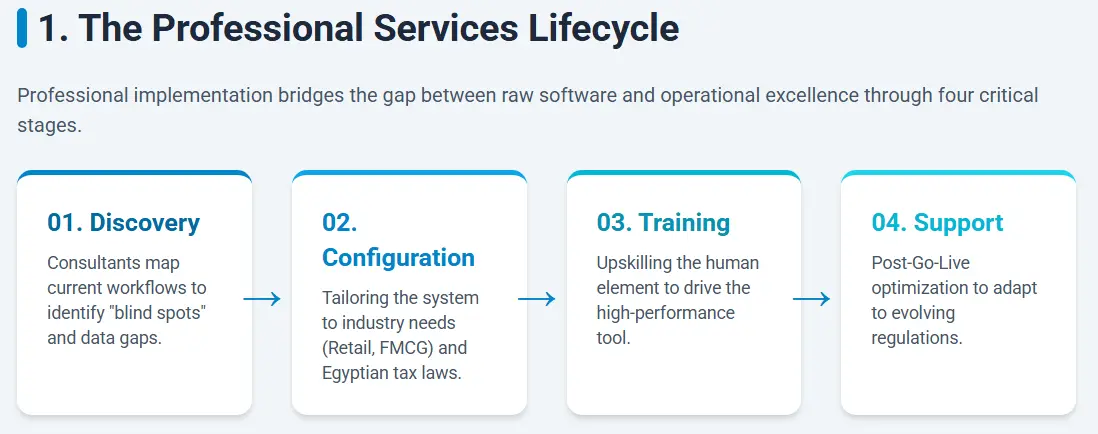
Professional erp implementation services guide you through a specific lifecycle. It begins with Discovery, where consultants map your current workflows to identify "blind spots." This moves into Configuration, where the system is tailored to your industry, followed by Training and Post-Go-Live Support. Without these professional services, you risk buying a high performance tool that your team does not know how to operate.
The ROI of Enterprise Resource Planning Implementation in Egypt
In the 2026 Egyptian market, the return on an enterprise resource planning implementation is measured by efficiency and compliance.
Manual Labor Reduction: Automating the sync between your sales and the ETA E-Invoicing portal can save an accounting team roughly 30 to 40 hours per month.
Inventory Accuracy: Industry data suggests a successful erp implementation can reduce inventory carrying costs by 10% to 20% through better demand forecasting, particularly when using specialized retail ERP and inventory management software in Egypt.
The Math: (Hours saved on manual entries x Hourly rate) + (Reduction in tax penalty risks) + (Value of optimized stock) = Your Annual ROI.
Why Local ERP Implementation Experience is Critical for Success
Global software follows global standards, but Egypt has unique regulatory requirements. An erp implementation experience that lacks local context will likely stumble when facing EGP currency volatility or the specific technical handshakes required by the Egyptian Tax Authority. A local partner understands the Egyptian workplace culture, where personal relationships often drive workflows, and knows how to translate that into a digital framework during the erp implementation process.
Building an Enterprise Resource Planning System Implementation Plan
An erp implementation fails without a roadmap that accounts for the specific friction points of your department's daily tasks. Most projects stall because the erp implementation plan focuses on software features instead of user behavior. A strategic erp implementation project plan acts as a contract between your vision and the technical execution.
Step 1: Process Auditing and Strategic Gap Analysis
Before writing a single line of code, you must audit your current state. Where does information stop moving? A gap analysis compares your existing as-is processes against the to-be capabilities of the software. During this stage of implementing erp solutions, you identify which business requirements are standard and which require specific customization to fit Egyptian regulatory or operational needs, especially when tailoring an ERP system for manufacturing environments.
Step 2: Developing a Robust ERP Implementation Project Plan
Your erp implementation project plan must include hard deadlines for every milestone. This includes infrastructure readiness, module configuration, and the Go-Live date. A common mistake is treating the erp implementation plan as a static document. In reality, it is a living schedule that must account for 15% to 20% buffer time for unforeseen technical hurdles or data discrepancies.
Step 3: Data Migration and Cleansing of Legacy Financial Records
A successful erp implementation is only as good as the data you feed it. Many Egyptian firms attempt to migrate years of unorganized Excel sheets into a new system, resulting in immediate errors. Data cleansing involves identifying duplicate vendors, correcting historical tax entries, and standardizing naming conventions. This step ensures your enterprise resource planning system implementation begins with a clean slate.
Step 4: User Acceptance Testing (UAT) and Training Sessions
UAT is the final gate. Your employees must verify that the erp implementation actually solves their problems. If a warehouse manager cannot log a shipment in under two minutes, the system is not ready. Training should be role-specific rather than a general overview. An accountant needs to know about the general ledger, while a sales rep only needs to understand the CRM and quotation workflow within the erp system implementation. For smaller teams, choosing the right ERP software for small business in Egypt can simplify this training phase significantly.
Technical Requirements for ERP System Implementation in Egypt
Implementing an ERP in Egypt involves navigating specific technical hurdles that don't exist in other markets. For an erp implementation to succeed here, your infrastructure must accommodate both modern regulatory APIs and the realities of a fluctuating economy.
Integrating the Accounting Module Odoo with ETA E-Invoicing
In 2026, compliance is the baseline for any successful erp implementation. Integrating Odoo or similar systems with the Egyptian Tax Authority (ETA) requires more than just a software connection. You must register your ERP on the ETA portal to obtain API credentials, including a Client ID and Secret.
The technical setup involves:
Digital Signatures: Each authorized user needs a physical USB token (from providers like Egypt Trust or MCDR) to sign invoices.
Local Proxy: You must install a local proxy server to link the physical USB hardware with your cloud-based Odoo database.
Unified Coding: Every product must be mapped to Global Standards 1 (GS1) or Egyptian Goods and Services (EGS) codes. Without this mapping, the ETA portal will reject your submissions, halting your sales cycle.
Managing Multi-Currency Workflows and EGP Volatility
Egyptian businesses often deal with suppliers in USD or EUR while operating in EGP. An erp system implementation must handle daily exchange rate updates automatically. If your system relies on manual updates, a 5% currency swing could lead to massive pricing errors or understated liabilities.
Standard erp implementation services should configure:
Automated Rate Feeds: Linking the ERP to central bank data.
Revaluation Modules: Automatically calculating "Unrealized Gain/Loss" on foreign currency balances at month-end.
Currency Buffers: Allowing for specific "landed cost" calculations that account for customs and clearing fees in foreign currency.
Scaling Infrastructure: Cloud vs. On-Premise ERP Solutions
A major decision in implementing erp solutions is where the data lives. In Egypt, this choice is often a trade-off between speed and control.
Feature | Cloud ERP (SaaS) | On-Premise ERP |
Upfront Cost | Low (Subscription) | High (Servers + Licenses) |
Implementation Speed | 3 to 6 months | 12 to 18 months |
Security | Handled by provider | Internal responsibility |
Connectivity | Requires stable internet | Local network access |
The hard truth: While on-premise offers total data control, the cost of maintaining specialized servers in Egypt, including cooling and backup power for electricity outages, often makes Cloud ERP in Egypt the more predictable financial choice for mid-sized firms.
Challenges and Solutions in Implementing ERP Solutions
The software is rarely the reason an erp implementation fails. The failure usually happens at the desk of the person using it. Identifying these friction points early is the only way to ensure a successful erp implementation.
Overcoming Resistance to Change in the Egyptian Workplace
Employees often view a new enterprise resource planning implementation as a threat to their job security or a tool for micromanagement. This resistance manifests as "shadow accounting," where staff continue using private Excel sheets instead of the ERP.
To solve this:
Involve Power Users Early: Let department heads test the system during the erp implementation experience so they feel ownership.
Transparent Communication: Explain how the system removes the "grunt work" of manual entry, rather than replacing the person.
Ensuring Post-Go-Live Support and Continuous System Audits
Many businesses treat the "Go-Live" date as the finish line. In reality, it is the starting line. Within the first 90 days of an erp implementation, users will find bugs or realize they missed a specific reporting requirement. A robust erp implementation project plan must include a three-month hyper-care period where consultants are on-site to fix errors in real-time.
Handling Customizations vs. Standard ERP Implementation Services
One of the biggest budget killers is "over-customization." Every time you ask a consultant to change the software's core code to match a legacy habit, you increase the cost and make future upgrades harder.
The 80/20 Rule: Aim to meet 80% of your needs with "out-of-the-box" features.
Customization Threshold: Only customize the remaining 20% if it provides a specific competitive advantage or is required by Egyptian law.
Final Reality Check: Is It Worth It?
The hard truth about implementing erp solutions: It is a difficult, time-consuming process that requires a significant financial and emotional investment from your leadership. You will face data errors, user frustration, and likely a few late nights during the transition.
However, the alternative is staying stagnant. Without an integrated enterprise resource planning implementation, you are flying blind. You cannot accurately predict your cash flow, you cannot optimize your inventory, and you risk non-compliance with the ETA.
This week, conduct a Data Speed Audit: Ask your finance lead to generate a total sales-vs-profit report for the last quarter. If it takes longer than 15 minutes to produce an accurate number, your current system is already costing you more than an erp implementation ever would.
Check this out: Cloud Inventory System for Scalable Business Operations