
Can you run your production costs for last month right now? If you need more than 10 minutes and three different spreadsheets, you're bleeding money.
Egyptian small manufacturers face a specific problem: traditional ERP systems for manufacturing were built for multinational corporations with IT departments and million-pound budgets. A typical SAP or Oracle implementation costs between EGP 500,000 to EGP 2 million before you process a single work order. For a factory with 30 employees producing furniture, machinery parts, or food products, that math doesn't work.
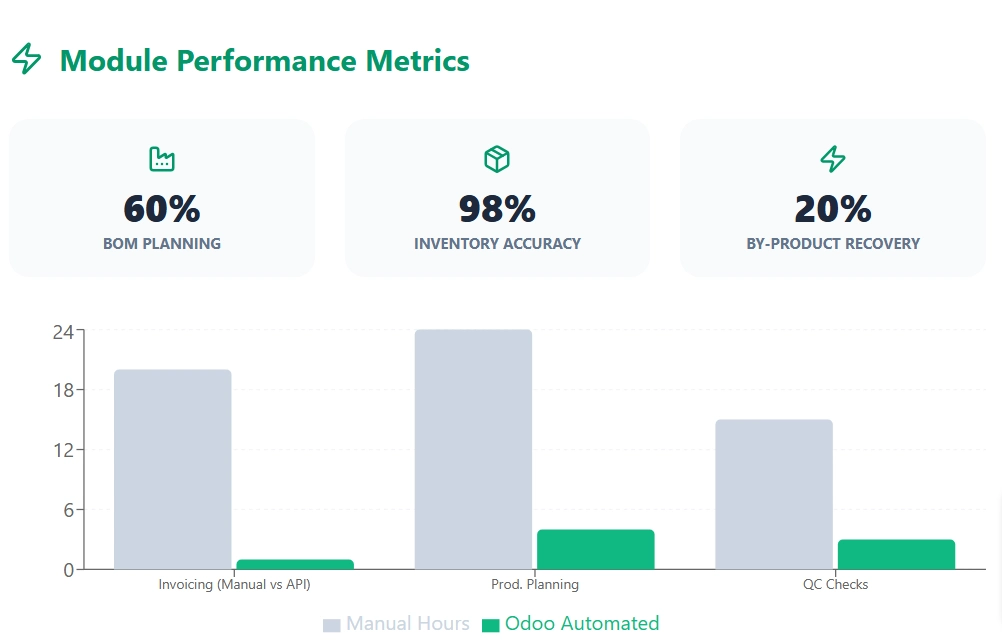
Odoo changes the cost structure. The software itself is open-source. You pay for implementation (EGP 50,000-150,000 depending on complexity) and hosting (EGP 2,000-8,000 monthly for cloud hosting, or you can self-host). A furniture workshop in 10th of Ramadan City switched from manual Excel tracking to Odoo and cut their production planning time from 6 hours per week to 45 minutes. Their manufacturing manager tracked the difference over three months using timestamped work order completions.
How many hours does your production team spend hunting for inventory numbers each week? That time has a cost.
Affordable ERP Licensing vs. Traditional Industrial Software
Traditional industrial software charges per user, per module, per year. A five-user license for inventory and production planning typically runs EGP 80,000-120,000 annually with companies like SAP Business One or Microsoft Dynamics.
Odoo Community Edition is free. Odoo Enterprise costs approximately $25 per user per month (roughly EGP 775 at current rates, though pricing fluctuates). For a 15-person factory, that's EGP 11,625 monthly or EGP 139,500 yearly with unlimited modules.
The math: If your manual processes cost more than EGP 12,000 per month in wasted labor, errors, or delayed orders, an ERP system for manufacturing pays for itself. Count your production manager's hours spent chasing material quantities. Add your accountant's time reconciling actual costs against estimates. Multiply by your average hourly wage. That's your baseline.
When you implement an ERP system for manufacturing, the licensing model determines your long-term costs. Odoo's per-user pricing scales with your factory. Traditional software locks you into annual contracts with escalating renewal fees.
Scaling from a Small Workshop to a Full Production Line
Most Egyptian manufacturers start with one product line. You track orders on paper, buy materials based on gut feel, and your "inventory system" is walking to the warehouse to count boxes.
That works until you hit 20 orders per month. Then the system breaks.
The breaking point usually looks like this: You accept a large order. You promise delivery in two weeks. Three days in, you discover you're short on raw materials because another order consumed them. You scramble to buy more, but your supplier needs five days. The client threatens to cancel. You lose EGP 30,000 in profit trying to fix a problem that shouldn't exist.
An ERP system for manufacturing scales with your operation. When you're producing 50 units monthly from a single workshop, Odoo tracks your bills of materials and inventory in real-time. When you expand to 500 units across two shifts, the same system handles multi-stage work orders without requiring a new software purchase.
The typical growth curve: At Stage A (startup), you manually schedule production. At Stage B (growth), manual scheduling creates bottlenecks and you miss deadlines. At Stage C (scale), you need automated planning or you're hiring people just to coordinate existing people. Where are you on this curve?
Direct Connection to the Egyptian Tax Authority (ETA) Portal
Egypt's e-invoicing law (implemented in phases starting 2021) requires manufacturers to submit invoices electronically through the ETA portal. Miss the submission window and you face penalties starting at EGP 20,000 per violation according to the Egyptian Tax Authority's enforcement guidelines.
Manual e-invoicing means your accountant logs into the ETA system, types invoice data, generates the required JSON format, and uploads it. For a manufacturer producing 100+ invoices monthly (customers, suppliers, materials), that's 15-25 hours of repetitive data entry.
Odoo connects directly to the ETA API. When you create a sales invoice in your ERP system for manufacturing, the system generates the compliant JSON format and submits it automatically. The invoice appears in both your accounting records and the ETA portal simultaneously. No duplicate entry. No missed submissions.
The honest requirement: You need an Odoo partner in Egypt who has already built the ETA integration module. This isn't standard in global Odoo it's Egypt-specific. Ask potential implementation partners for proof of existing ETA connections before signing a contract. Request to see a test invoice submission from their demo environment.
2B Cloud Solutions is an Odoo Gold Partner in Egypt specializing in manufacturing implementations. Gold Partner status is Odoo's highest certification tier, requiring documented implementations and ongoing technical training. When evaluating partners, verify their certification status directly on Odoo's official partner directory.
Automated Costing: Managing EGP Volatility in Raw Materials
Egyptian manufacturers face a costing problem most ERP guides ignore: your raw material prices change faster than your production cycle.
You quote a client EGP 50,000 for 100 metal cabinets in January. Steel costs EGP 18,000 per ton. You win the contract. Production starts in March. Steel now costs EGP 24,000 per ton. Your profit just disappeared, and you're contractually locked into the original price.
Manual costing can't keep up. By the time you recalculate costs in Excel and update your pricing, the market has shifted again. According to the Central Bank of Egypt's commodity price index, industrial raw materials fluctuated between 15-35% quarterly during 2022-2024 depending on import dependency and currency exchange rates.
An ERP system for manufacturing calculates costs automatically using current prices. When steel prices update in your purchasing module, Odoo recalculates the cost of every product containing steel. You see the new production cost immediately. Before quoting your next client, you check the system's current cost calculation not last month's spreadsheet.
The costing formula: (Raw Materials at Current Price) + (Labor Hours × Hourly Rate) + (Overhead Allocation) = True Production Cost. Odoo runs this calculation every time materials move. When you consume steel from inventory, the system uses the weighted average cost of all steel batches in stock, not an outdated estimate.
Do this quick math on your last major order: Compare your quoted price to your actual material costs at the time of production. If the difference exceeded 10%, you either lost profit or overcharged the client. How many orders can you afford to miscalculate?
Quality Control and Maintenance for Factory Equipment
Quality control in an ERP system for manufacturing means defining checkpoints before defects reach customers. For a textile factory: inspect fabric for tears before cutting, check stitching alignment before packaging, verify color consistency in each batch.
Odoo's quality control module creates inspection points within work orders. Stage 2 (dyeing) can't complete until a worker confirms the color matches the Pantone reference. The system requires a photo upload or a pass/fail checkbox. No checkbox, no progress. Production physically stops until someone inspects and approves.
The cost of skipping inspections: A furniture manufacturer in 6th of October shipped 200 chairs with unstable leg joints. The client returned the entire batch. Direct loss: EGP 180,000 in materials and labor. Indirect loss: contract cancellation and reputation damage. The defect originated in Stage 1 (cutting), but wasn't caught until the client received finished goods. An inspection checkpoint after cutting would have identified the problem when 10 chairs were affected, not 200.
Equipment maintenance connects to production scheduling. Your CNC machine needs servicing every 500 operating hours. Odoo tracks machine usage per work order. At 480 hours, the system alerts you to schedule maintenance. You plan downtime during low-demand periods instead of facing an emergency breakdown during a rush order.
Preventive maintenance saves money. Emergency CNC repairs cost EGP 15,000-30,000 plus 3-7 days of production loss. Scheduled maintenance costs EGP 3,000-5,000 and takes one day. The math is simple, but only works if you know when maintenance is actually due not guessing based on calendar dates.
Reducing Material Waste and Improving Production Timelines
Material waste happens in three places: over-ordering (buying more than needed), production errors (cutting mistakes, damaged materials), and inventory decay (materials expiring or degrading before use).
An ERP system for manufacturing reduces waste through accurate demand forecasting. The system analyzes your sales history: you sell 500 units in January, 300 in February, 800 in March. It identifies the pattern (March spike likely due to seasonal demand) and suggests purchase quantities. You order based on data, not gut feeling.
Production timeline improvement comes from identifying bottlenecks. Your furniture factory has three stages: cutting (2 hours), assembly (4 hours), finishing (2 hours). Assembly takes twice as long as other stages. That's your constraint. Adding more cutting capacity won't speed up production because assembled units already pile up waiting for finishing.
The Theory of Constraints (industrial engineering principle established by Eliyahu M. Goldratt) says you improve throughput by addressing the slowest stage first. Odoo's manufacturing analytics show you which stage accumulates the most work-in-progress inventory. Focus your improvement efforts there not everywhere at once.
Before/After workflow: Your current timeline likely involves checking multiple locations for data production sheets, inventory notebooks, purchasing records. Finding the answer to "Can we deliver 500 units in two weeks?" takes hours of coordination. With an ERP system for manufacturing, you open the planning screen, enter the quantity, and the system calculates availability based on current materials, machine capacity, and labor hours. Answer: two minutes.
The honest downside: This requires accurate data entry. If workers don't confirm work order completions in real-time, the system's timeline calculations become guesses. Training your team to use the system correctly takes 2-4 weeks. Don't expect instant results expect better results after the learning curve.
You've read about licensing costs, ETA compliance, inventory tracking, automated costing, and quality control. The information only matters if you do something with it.
Most Egyptian manufacturers delay ERP decisions because they're waiting for "the right time after this busy season, after hiring that new manager, after expanding the facility. Understanding which ERP system is right for your company in Egypt and how it differs from other systems like HRMS can help you make that decision. The right time was six months ago. The second-best time is now.