How much time did your accountant spend last month manually formatting invoices to match ETA requirements?
If the answer is "too much" or "I don't actually know," you're bleeding money into compliance work instead of growth activities. Egyptian small businesses face a unique challenge: You need enterprise-grade financial controls without enterprise-grade budgets.
Traditional ERP systems charge per user. At $50-150 per user monthly, a 10-person team costs $6,000-18,000 annually just for access. Before customization. Before training. Before the implementation consultant bills you for "scope changes."
Odoo for small business inverts this model entirely.
Here's the current state for most Egyptian SMEs: Accounting happens in Excel. Customer records live in scattered WhatsApp chats. Inventory tracking uses paper or a custom-built Access database from 2015. Payroll calculations follow Egyptian labor law through manual spreadsheet formulas that break when regulations change.
Then ETA mandates e-invoicing. Your patchwork system can't generate compliant XML files. You either hire a developer to build integration, pay a monthly SaaS fee for e-invoicing only, or manually bridge the gap between your internal records and the government portal.
None of these solutions scale. They're patches on a fundamentally disconnected system.
THE ROOT CAUSE:
This isn't a technology problem. It's an architecture problem.
Most small businesses build their tech stack backwards. They solve immediate pain points with isolated tools: One app for invoicing, another for inventory, a third for CRM. Each tool works fine independently. Together, they create data silos that require manual reconciliation.
An ERP for small business solves this by design. One database. One source of truth. When you create a sales order, it automatically updates inventory, triggers invoicing, records the transaction in accounting, and updates customer records. No manual transfer. No reconciliation gaps.
If you're still evaluating whether ERP makes sense for your business size or comparing different systems, our comprehensive breakdown of ERP software for small business in Egypt covers when the investment becomes justified based on transaction volume and team size.
Why Odoo is the Leading Choice for Small Businesses in Egypt (2026)
Three factors make Odoo for small business particularly suitable for the Egyptian market: regulatory compliance support, transparent pricing, and local implementation talent.
Solving the ETA E-Invoicing Challenge
The Egyptian Tax Authority's e-invoicing mandate created chaos for businesses using disconnected systems. Your accounting software needs to generate invoices in a specific XML format, sign them digitally, submit them to ETA servers, and handle rejection scenarios.
Odoo's Egyptian localization module handles this natively. When you create an invoice in Odoo, the system:
Generates the compliant JSON/XML structure
Applies the required digital signature
Submits to ETA via API
Stores the approval response
Updates the invoice status automatically
No middleware. No manual export-import cycles. No third-party e-invoicing platform charging monthly fees per document.
For a business processing 200 invoices monthly, third-party e-invoicing platforms typically charge 0.50-1.50 EGP per document. That's 1,200-3,600 EGP monthly (14,400-43,200 EGP annually) for basic compliance. Odoo includes this in the core system.
Total Cost of Ownership: Odoo vs. Traditional ERPs
Most ERP comparisons focus on licensing. That's incomplete math.
Total cost of ownership for an ERP for small business includes:
Licensing: User fees or subscription costs
Implementation: Consultant time to configure and deploy
Customization: Modifications for business-specific workflows
Training: Getting staff competent with the system
Maintenance: Updates, bug fixes, ongoing support
Infrastructure: Hosting, backups, security
Traditional ERP (SAP Business One, Microsoft Dynamics):
Licensing: $50-150 per user/month = 600,000-1,800,000 EGP annually for 10 users
Implementation: 150,000-500,000 EGP for basic setup
Customization: 50,000-200,000 EGP per major modification
First-year total: 800,000-2,500,000 EGP
Odoo for small business (Enterprise):
Licensing: One-app pricing starts at ~$7,000-10,000 USD annually (all users)
Implementation: 30,000-150,000 EGP depending on scope
Customization: 20,000-100,000 EGP per module
First-year total: 300,000-800,000 EGP
The difference compounds. Year two onwards, traditional ERPs maintain high user fees. Odoo's cost stabilizes around maintenance and new module additions.
For a detailed feature-by-feature comparison beyond just pricing including implementation complexity, customization limits, and vendor lock-in risks see our analysis of the difference between Odoo and traditional ERP.
Scalability: Starting with One App and Growing to Fifty
Most ERPs force all-or-nothing adoption. You buy the full suite whether you use 20% or 100% of features.
Odoo's modular architecture lets you start with exactly what you need today. A typical Egyptian small business implementation follows this pattern:
Month 1-3: Accounting + E-Invoicing (solve compliance crisis) Month 4-6: CRM + Sales (centralize customer data) Month 7-9: Inventory (eliminate stock discrepancies) Month 10-12: HR + Payroll (automate labor law calculations)
Each module activates when you're ready. You don't pay for unused features. You don't overwhelm staff with training on tools they won't use for six months.
This matters for cash flow. Instead of 800,000 EGP upfront, you might spend 200,000 EGP on accounting and e-invoicing in quarter one, then add 100,000 EGP for CRM in quarter two. The business generates revenue between implementations, making the investment self-funding.
Essential Odoo Modules for the Egyptian SME Roadmap
Don't implement everything at once. That's how projects fail.
Successful Odoo deployments follow a phased approach: solve the biggest pain point first, stabilize, then add the next module. For Egyptian businesses, compliance typically drives phase one.
Phase 1: Accounting & Financial Localization
Start here. Egyptian accounting has non-negotiable requirements:
ETA e-invoicing integration
Arabic chart of accounts
VAT calculations matching Egyptian tax brackets
Bank reconciliation with local bank formats
Odoo's Egypt localization package includes all four. Implementation time: 4-6 weeks for a standard manufacturing or trading business.
Critical setup: Your chart of accounts must match ETA's required structure. Don't customize this creatively. Use the standard Egyptian template, then add your specific sub-accounts underneath.
Cost range: 30,000-80,000 EGP for accounting module implementation including e-invoicing setup.
Phase 2: CRM & Sales Automation for Local Markets
Once accounting is stable, centralize customer data. Most Egyptian SMEs have customer information scattered across:
WhatsApp business chats
Excel contact lists
Email threads
Sales rep personal phones
Odoo CRM consolidates this into one system. Every customer interaction calls, emails, quotations, orders links to the customer record. You can finally answer "What's our history with this client?" in 10 seconds instead of asking three people.
Sales automation handles:
Lead assignment by territory (Cairo, Alexandria, Delta regions)
Quotation generation with Arabic/English templates
Follow-up reminders based on Egyptian business calendar (accounting for holidays)
Pipeline visibility across sales team
Implementation: 3-4 weeks. Cost: 25,000-60,000 EGP.
Phase 3: Inventory & Supply Chain Management
Inventory errors cost Egyptian businesses approximately 5-15% of revenue annually through stockouts, overstocking, or shrinkage, based on retail industry benchmarks.
Odoo inventory tracks:
Real-time stock levels across multiple warehouses
Automatic reorder points
Barcode scanning integration
Landed cost calculations (important for imports through Egyptian customs)
The customs integration matters. When you import goods, the true cost isn't just the supplier invoice. It's invoice + shipping + customs duties + clearance fees. Odoo calculates landed cost automatically, giving you accurate profit margins.
Implementation: 4-6 weeks. Cost: 35,000-90,000 EGP depending on warehouse complexity.
Phase 4: Egyptian Labor Law Compliant HR & Payroll
Egyptian labor law is specific:
Social insurance calculations at current rates
Annual leave accrual rules
End of service benefits computation
Tax brackets and exemptions
Manual payroll breaks when regulations change. The social insurance rate increased in 2023. Did your Excel formula update correctly? Are you calculating the employee vs. employer contribution split properly?
Odoo HR manages:
Payroll with Egyptian tax and social insurance tables
Leave management tracking annual, sick, emergency leave separately
Attendance tracking
End of service calculation based on Egyptian Labor Law 12/2003
Implementation: 4-5 weeks. Cost: 30,000-75,000 EGP.
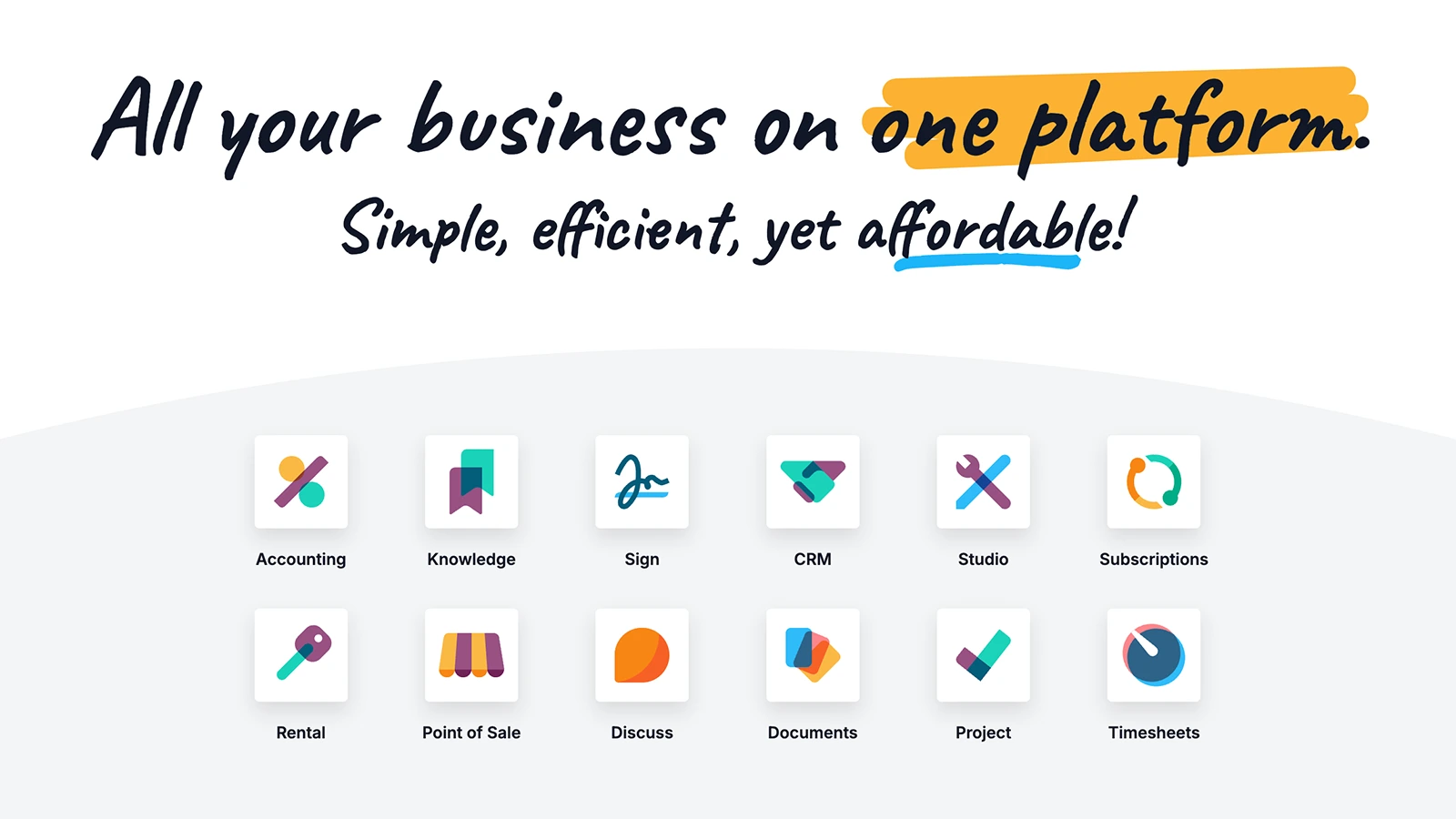
Beyond these four core phases, Odoo offers 50+ additional modules for manufacturing, e-commerce, project management, and more. The key is knowing which modules matter for your specific industry and compliance requirements. Our guide to Odoo modules for Egyptian businesses breaks down module selection by sector retail, distribution, manufacturing, and services.
Odoo Enterprise vs. Community: Which Version Fits Your Startup?
Odoo comes in two versions. The choice isn't obvious, and wrong decisions cost money.
Community Edition: Free, open-source, self-hosted. You pay zero licensing fees.
Enterprise Edition: Paid licensing, includes official support, mobile apps, and advanced features.
The pricing difference seems straightforward. Community costs nothing. Enterprise costs $7,000-10,000 USD annually for a small business package.
But that's incomplete math.
Feature Gaps in Accounting and E-Invoicing
Here's what Community lacks that matters for Egyptian businesses:
No official ETA e-invoicing module. You can find community-developed e-invoicing modules, but they're not officially supported. If ETA changes the API requirements (which happened twice in 2024), you're waiting for a volunteer developer to update the module.
No accounting reports matching Egyptian formats. Community has basic reports. Enterprise includes pre-built templates for Egyptian tax declarations, financial statements, and audit trails.
No mobile apps. Enterprise includes iOS and Android apps. Community requires third-party mobile solutions.
No studio module. Enterprise's Studio lets you customize forms and workflows without code. Community requires developer work for similar changes.
Calculate this: If you choose Community to save licensing fees, but spend 40,000 EGP on custom e-invoicing development, 20,000 EGP on mobile app integration, and 30,000 EGP on report customization, you've spent 90,000 EGP. Enterprise licensing for one year costs approximately 180,000-250,000 EGP (depending on modules), but includes all these features supported.
Hosting Options: Odoo Online, Odoo.sh, or Local Servers?
Odoo Online (SaaS): Odoo hosts everything. You access via browser. No infrastructure management.
Cost: Included with Enterprise licensing
Pros: Zero IT overhead, automatic updates, guaranteed uptime
Cons: Limited customization, data stored outside Egypt
Odoo.sh (Platform-as-a-Service): Odoo manages servers, you control customizations.
Cost: Additional $21/month per developer environment
Pros: Full customization access, automated deployments, staging environments
Cons: Requires technical knowledge, more expensive than Online
Self-Hosted (On-Premise or VPS): You manage everything.
Cost: Server costs only (5,000-15,000 EGP monthly for quality hosting)
Pros: Complete control, data stays in Egypt, no vendor dependency
Cons: You handle backups, security, updates, troubleshooting
For Egyptian small businesses with data residency concerns or government clients requiring local hosting, self-hosted or Egyptian-based VPS makes sense. For companies prioritizing simplicity, Odoo Online eliminates infrastructure headaches.
Strategic Pros and Cons of Odoo for Egyptian Business Owners
Every ERP has tradeoffs. Here's the honest assessment for Odoo for small business in Egypt.
The "Pros": Flexibility, Local Talent, and No Per-User Fees
Flexibility: You're not locked into vendor workflows. If Odoo's default sales process doesn't match how Egyptian distributors actually operate, you change it. Traditional ERPs make you adapt to their process.
Local Talent: Egypt has a strong Odoo developer and consultant community. Finding qualified implementers in Cairo or Alexandria is straightforward. Finding SAP Business One consultants? Much harder and more expensive.
Pricing Model: One license covers unlimited users. Your business grows from 5 to 50 employees? Same license cost. Traditional ERPs would charge 45 additional user fees.
Open-Source Foundation: If you outgrow your current implementer or disagree on pricing, you switch consultants. Your data and customizations aren't locked to one vendor. The code is yours.
The "Cons": Avoiding the Customization Trap and Implementation Risks
Customization Trap: Odoo's flexibility becomes dangerous. Every department wants custom features. "Can you add a button that..." "We need a special report for..." "Our process is unique, so..."
Each customization adds:
Development cost (15,000-50,000 EGP per significant modification)
Maintenance burden (updates might break custom code)
Training complexity (staff must learn non-standard workflows)
Rule: Customize only when the business process genuinely differs from industry norms and changing the process costs more than customization.
Implementation Risk: Poor implementers exist. They promise everything, deliver half-functional systems, then disappear when bugs emerge. Egyptian business forums are full of "Odoo implementation disaster" stories.
The pattern: Cheap implementer quotes 60,000 EGP. Doesn't properly analyze requirements. Builds customizations instead of using standard features. Goes over budget. Delivers buggy system. Business gets stuck with unusable ERP.
These aren't hypothetical warnings. We've documented real implementation failures and successes in our honest guide to Odoo ERP in Egypt, including what actually causes projects to fail and how to avoid common pitfalls that Egyptian businesses encounter.
Module Interdependencies: Some Odoo modules interact in non-obvious ways. Activate inventory with manufacturing without proper setup, and your cost calculations break. This requires implementer expertise to navigate.
How to Implement Odoo for Your Small Business in 5 Steps
Most implementation failures happen in planning, not execution.
You can't fix a poorly scoped project with better developers. If you skip business process analysis and jump straight to configuration, you'll build the wrong system efficiently.
Step 1: Gap Analysis & Business Process Mapping
Document your current workflows before touching Odoo. Not what you wish you did. What actually happens.
Map three categories:
1. Standard Processes: Tasks that follow industry norms. (Example: Purchase order → Goods receipt → Vendor invoice → Payment)
2. Unique Processes: Workflows specific to your business. (Example: Multi-level approval for government contracts, special pricing for repeat customers)
3. Broken Processes: Current methods that waste time. (Example: Manually re-entering customer data across three systems)
For standard processes, use Odoo's default workflows. For unique processes, evaluate whether they're truly necessary or just legacy habits. For broken processes, redesign them using Odoo's best practices rather than automating inefficiency.
Time investment: 1-2 weeks for a small business with 10-20 staff. Do this internally before hiring an implementer. You'll save 30-40% on consulting costs when you can clearly articulate requirements.
For a comprehensive breakdown of ERP readiness assessment, see our guide on ERP implementation services in Egypt.
Step 2: Choosing a Certified Local Implementer in Egypt
Three questions determine implementer quality:
1. How many similar businesses have they implemented? If you're a pharmaceutical distributor, has the implementer worked with other pharma distributors in Egypt? Industry knowledge reduces project risk.
2. What's their post-implementation support model? Some implementers disappear after go-live. You need ongoing support for the first 3-6 months as issues emerge.
3. Do they push customization or configuration? Good implementers exhaust standard features before suggesting custom development. Bad implementers see every requirement as a customization opportunity (because they bill more).
Red flags:
Unwilling to provide client references
Quote is 40%+ cheaper than other certified partners
Promise delivery timelines under 6 weeks for multi-module implementations
Use phrases like "we can build anything" without asking about your business processes
Cost range for qualified implementers: 30,000-150,000 EGP depending on modules and complexity. For detailed criteria on evaluating Odoo partners in Egypt, reference our guide to choosing the right Odoo partner.
Step 3: Data Migration and Cleansing Strategy
Your current data is messier than you think.
Common issues Egyptian businesses discover during migration:
Customer records with incomplete addresses or phone numbers
Duplicate entries (Ahmed Mohamed appears 4 times with slight spelling variations)
Inventory items missing cost data or proper categorization
Inconsistent product naming (same item called three different things)
Clean data before migration, not after. Migrating garbage means you'll spend months fixing it inside Odoo.
Data cleansing process:
Export current data from all sources (Excel, old software, paper records)
Identify duplicates using phone numbers or tax IDs as unique identifiers
Standardize formats (all phone numbers as +20-XXX-XXX-XXXX, all addresses with governorate field)
Fill gaps in critical fields (customer payment terms, product costs)
Test migration on Odoo staging environment
Time investment: 2-4 weeks. This is boring work. Do it anyway. Clean data prevents 80% of post-implementation complaints about "the system showing wrong information."
Step 4: User Acceptance Testing (UAT) and Training
Don't train users on generic Odoo features. Train them on your configured system using your real data.
Bad training: "Here's how to create a sales order in Odoo." Good training: "Here's how to create a sales order for a repeat customer in Cairo with our standard payment terms, apply the distributor discount, and check inventory availability."
UAT identifies configuration gaps before go-live. Have actual users complete actual tasks:
Sales team processes 10 real quotations
Accounting closes a month of transactions
Warehouse receives goods and updates stock
HR processes one payroll cycle
Each gap discovered in UAT costs 5,000-15,000 EGP to fix. Same gap discovered in production costs 20,000-40,000 EGP because you're disrupting live operations.
Training allocation: 2-3 days of hands-on training per user role. Accountants need different training than sales reps. Don't waste warehouse staff time teaching them CRM features they'll never use.
Step 5: Go-Live and Ongoing Support (Hypercare)
Go-live isn't the end. It's the beginning of the real test.
Schedule go-live during your slowest business period. Don't launch a new ERP the week before Ramadan ends or during your peak season. You need breathing room to handle unexpected issues.
Hypercare period (first 30-90 days post-launch):
Implementer available for same-day issue resolution
Daily check-ins on system performance
Rapid fixes for blocking bugs
Process adjustments based on real usage
Budget 20-30% of implementation cost for hypercare support. A 100,000 EGP implementation should include 20,000-30,000 EGP for post-launch support.
Common go-live issues:
Users reverting to old systems because "it's faster" (actually they're avoiding learning)
Integration glitches with banks or ETA that didn't appear in testing
Performance problems under real transaction volume
Missing reports or workflows discovered only during actual use
For detailed timeline and cost breakdowns of each implementation phase, see our article on Odoo implementation steps, costs, and timeline.
The Future of Your Business: Odoo 19 and AI-Driven Growth
Odoo 19 introduces AI-powered features that matter for Egyptian small businesses.
Predictive inventory management: The system learns your sales patterns and suggests reorder quantities based on seasonal trends, not just static minimum levels. For businesses with Ramadan spikes or summer slowdowns, this prevents both stockouts and overstock.
Smart invoice matching: AI automatically matches supplier invoices to purchase orders and receipts, flagging discrepancies. This cuts invoice processing time by 60-70% based on early Odoo 19 adopter reports.
Automated customer segmentation: The CRM analyzes purchase history and behavior to automatically categorize customers into high-value, at-risk, or growth-potential segments.
The competitive advantage isn't the AI features themselves. It's implementing them while your competitors are still using Excel.
Egyptian market context: Businesses that adopted ERP systems in 2020-2022 grew 15-25% faster than competitors using manual systems, according to Egyptian Ministry of Communications and Information Technology reports. Not because ERPs magically create growth, but because they eliminate the operational ceiling that manual systems impose.
You can't scale a business built on WhatsApp messages and Excel sheets. At 50-100 transactions monthly, manual works. At 500 transactions, it breaks. At 5,000 transactions, it collapses.
Odoo for small business removes that ceiling before you hit it.
The honest assessment of Odoo implementation:
Expect frustration in weeks 2-4. Your staff will complain. "The old way was easier." They're wrong, but they genuinely feel that way because change is uncomfortable.
By week 8, complaints reduce. By week 12, most users prefer the new system. By month 6, reverting to the old way becomes unthinkable.
Start with one pain point this quarter. For most Egyptian businesses, that's ETA e-invoicing compliance. Get accounting and invoicing stable first.
Then add CRM next quarter. Then inventory. Then HR.
Trying to implement everything simultaneously guarantees failure. Phased deployment guarantees success.
Next step: Calculate your current cost of manual processes. Count the hours spent on:
Invoice formatting for ETA compliance
Customer data searches across multiple tools
Inventory reconciliation
Payroll calculations
Multiply those hours by your fully-loaded labor cost. That number is what staying with your current system actually costs.
Multiply those hours by your fully-loaded labor cost. That number is what staying with your current system actually costs.
Your decision framework:
If that annual cost exceeds 150,000 EGP, Odoo implementation pays for itself in year one. If it's between 80,000-150,000 EGP, you break even by month 18. Below 80,000 EGP, you might wait another year until transaction volume increases.
The choice isn't between implementing now or never. It's between implementing before the manual system breaks or after it's already created a crisis.
check this guide for more info: guide to odoo erp in egypt
Most Egyptian small businesses make the decision after one of three breaking points:
Failed ETA audit due to invoicing errors
Major customer lost because inventory data was wrong
Payroll miscalculation that violates labor law
All three are expensive fixes that could've been prevented.
Start your gap analysis this week. Map your five most time-consuming manual processes. Calculate the hours. That's your baseline.
Implementation takes 3-6 months. Waiting to start costs you another quarter of manual inefficiency.
The research takes time. The implementation takes longer. But continuing with disconnected systems costs more than both.
Read also about: Odoo Community vs. Enterprise