Can you generate a VAT report or an ETA-compliant e-invoice in under two minutes right now? If you are still manually uploading Excel sheets to the tax portal or struggling to reconcile bank statements across EGP and USD accounts, your system is failing you. For most Egyptian finance managers, the "old way" of accounting stops working the moment the business scales beyond a few dozen transactions a day.
The odoo accounting system isn't just a digital ledger, it is a compliance engine. In Egypt, where tax laws and currency values shift rapidly, using odoo for accounting allows businesses to move from reactive firefighting to proactive financial management. By automating the connection between your sales and the Egyptian Tax Authority (ETA), you eliminate the human error that leads to costly audits.
Is Odoo Good for Accounting in the Egyptian Market?
Yes, but only if configured correctly for local laws. While Odoo is a global platform, its strength in Egypt lies in its flexibility to handle the specific requirements of the Egyptian Tax Authority (ETA). According to recent market trends, over 60% of medium-to-large Egyptian enterprises moving away from legacy systems choose odoo finance because it integrates localized features like WHT (Withholding Tax) and e-invoicing natively.
Core Features of the Accounting Module Odoo
The accounting module Odoo functions as a double-entry system that automates the "boring" parts of bookkeeping. It features automated bank synchronization, AI-powered invoice digitization (OCR), and dynamic financial reporting. Unlike traditional software, odoo accounting links every transaction directly to other departments inventory, sales, or manufacturing ensuring that your balance sheet reflects real-world stock levels and orer statuses in real-time.
Adhering to Egyptian Accounting Standards (EAS) vs. IFRS
While many platforms focus solely on IFRS, the odoo accounting module can be tailored to meet Egyptian Accounting Standards (EAS). The primary difference often lies in the treatment of fixed asset depreciation and the specific presentation of the income statement. A local implementation ensures your Chart of Accounts (COA) is mapped to satisfy both internal management needs and external auditor requirements under EAS. This distinction is critical for businesses operating in free zones or those with foreign investors who require a clear difference between Odoo and traditional ERP systems.
Multi-Currency Management: Handling EGP, USD, and EUR Volatility
Managing currency volatility is a survival skill in Egypt. Odoo accounting handles multi-currency transactions by fetching real-time exchange rates (or manual central bank rates) and automatically calculating realized and unrealized gains or losses. This ensures that your financial reports accurately reflect the impact of EGP fluctuations on your cash flow and payables. If you are importing raw materials or exporting services, this automation prevents the "hidden" losses often found in manual spreadsheets.
Managing Local Tax Compliance with Odoo Accounting?
Odoo accounting handles Egyptian tax compliance by hard-coding local tax rules into your automated workflows. Instead of manually calculating taxes at the end of the month, the system applies the correct VAT and withholding tax (WHT) rates the moment an invoice is generated. This reduces the risk of human error and ensures your records match what the Egyptian Tax Authority (ETA) expects to see during an audit.
Automated ETA E-Invoicing and E-Receipt Integration
As of 2026, the mandate for electronic documents in Egypt covers nearly all registered taxpayers. Odoo accounting bridges the gap between your internal sales and the ETA portal via a direct API connection. When you confirm a "Customer Invoice" in the odoo accounting module, the system sends the JSON file to the ETA for validation.
If the document is accepted, you receive a unique UUID and a QR code instantly. This process removes the need for the manual "Excel upload" method, which is prone to rejection due to formatting errors. For a deep dive into the technical requirements, see this comprehensive e-invoicing Egypt compliance guide.
Automating VAT (14%) and Withholding Tax (WHT) Reports
Standard VAT in Egypt is 14%, but managing it alongside Withholding Tax (Form 41) is where most manual systems break down. Odoo for accounting uses "Tax Positions" to automatically map 1% or 3% WHT based on the vendor type or service category.
VAT Reporting: The system generates a pre-filled report that matches the structure of the ETA’s VAT return form.
WHT Management: It tracks amounts withheld from payments to suppliers, allowing you to export the "Form 41" report directly.
This automation ensures that you never pay more tax than necessary due to lost receipts or miscalculated deductions. You can find more about the necessary odoo modules for Egyptian businesses to handle these local nuances.
Odoo Finance: Real-time Dashboards for Egyptian Business Owners
The primary benefit of odoo finance for an owner is visibility. Most Egyptian business owners only see their "true" financial position weeks after the month ends. Odoo provides a real-time dashboard showing:
Aged Receivables: Who owes you money and for how long?
Cash Flow Forecast: Can you cover your USD liabilities next month?
Profitability by Project: Which contracts are actually making money after factoring in the current EGP exchange rate?
Having this data at your fingertips prevents the common scenario of "profitable on paper, but no cash in the bank."
Comparing Odoo for Accounting with QuickBooks and Zoho
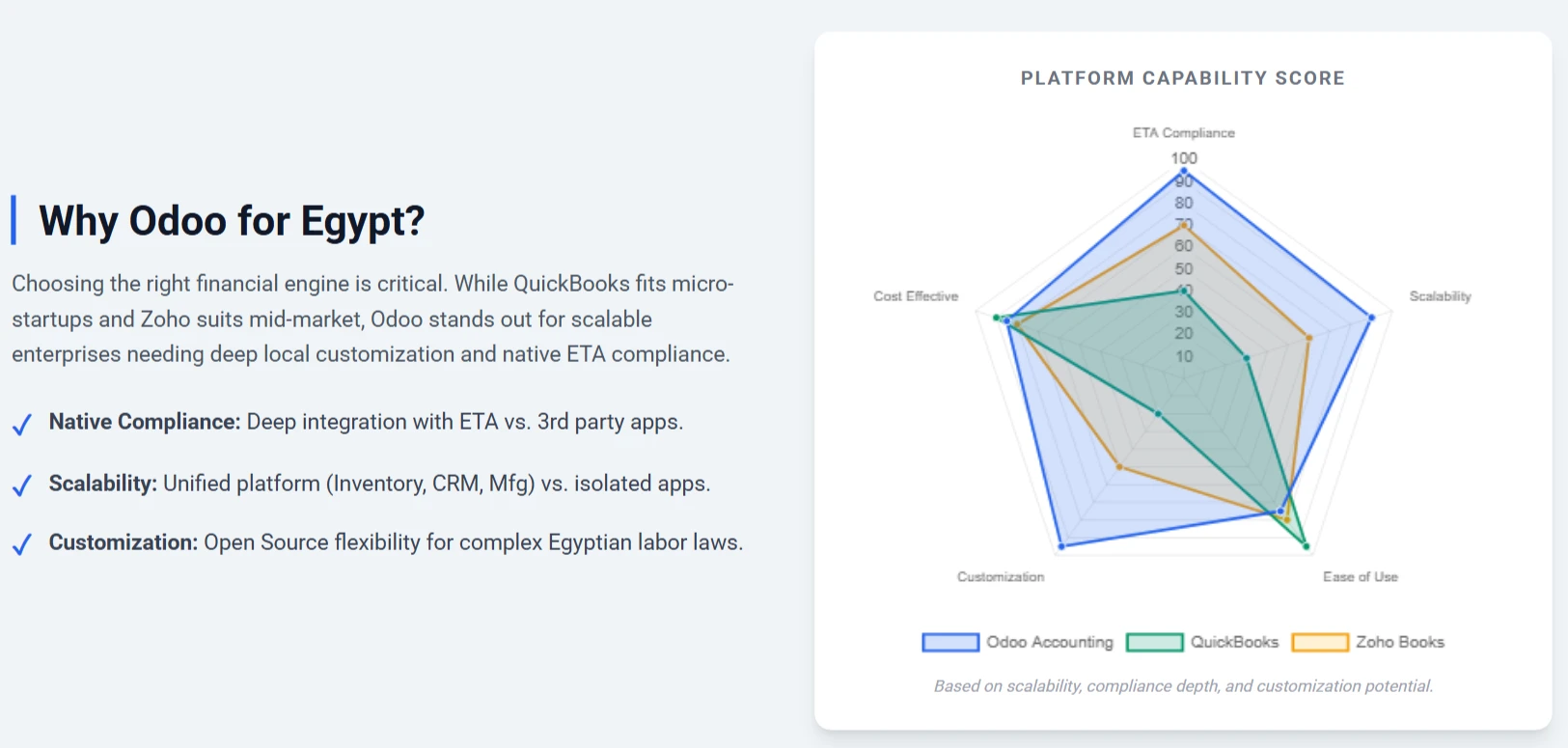
When choosing between odoo for accounting, QuickBooks, and Zoho, the decision usually rests on whether you need a simple tool or a scalable business engine. While all three offer cloud access and basic bookkeeping, their ability to handle the "Egyptian complexity" such as mandatory e-invoicing and EGP volatility varies significantly.
Feature | QuickBooks Online | Zoho Books | Odoo Accounting |
Best For | Very small startups | Mid-market SMEs | Scalable SMEs & Enterprises |
ETA Compliance | Via 3rd party apps | Built-in (Limited) | Native / Deep Integration |
Scalability | Accounting only | Suite of linked apps | Unified Modular Platform |
Customization | Low (Fixed) | Medium | High (Open Source) |
Which is Better: QuickBooks or Odoo for Egyptian SMEs?
For a micro-business with 1 - 3 employees, QuickBooks is often the first choice because of its "plug-and-play" simplicity. However, many Egyptian SMEs outgrow it within 18 months. The primary reason is that QuickBooks is a standalone accounting tool. As soon as you need to link your sales to warehouse stock or manage complex manufacturing costs in EGP, QuickBooks hits a ceiling.
In contrast, the odoo accounting module is part of a larger ecosystem. If you start with accounting and later need a CRM or Inventory system, you simply turn those modules on. There is no data migration or "syncing" needed because the data already lives in the same database. If you're weighing these options, a guide to choosing the right Odoo partner can help you determine if your growth trajectory warrants an ERP-level solution.
Is Zoho or Odoo Better for Large Scale Egyptian Enterprises?
Zoho Books is a strong contender for mid-sized companies, but for large-scale Egyptian enterprises, odoo accounting typically wins on "Information Density" and customization. Zoho operates as a suite of separate apps that "talk" to each other via APIs. While functional, this can lead to data lags or "sync errors" in high-volume environments.
Large enterprises in Egypt often have non-standard workflows such as complex payroll structures or specific customs-clearance tracking. Because Odoo is open-source, odoo accounting firms can modify the core code to fit these specific business rules. Zoho, being proprietary "Black Box" software, limits you to the features they choose to provide. For a deep dive into the costs involved in this level of setup, check this breakdown of Odoo implementation steps and costs.
Addressing the Challenges and Disadvantages of Odoo Accounting
The honest downside: Odoo accounting is not a "plug-and-play" miracle. If you expect to install it on Monday and have a perfect balance sheet by Tuesday, you will be disappointed. Transitioning your entire financial workflow is a high-effort undertaking that requires clean data and a disciplined team. What if you invest heavily in a new system only to find your staff continues to keep "shadow" records in Excel because the software feels too complex? That is the reality for many failed implementations.
What are the Disadvantages of Odoo Accounting for Local Users?
The primary disadvantage for Egyptian users is the steep learning curve. Unlike basic tools, the accounting module odoo follows strict double-entry principles that do not allow for "shortcuts." If an entry is validated, you cannot simply delete it; you must issue a credit note or a reversal.
Additionally, while the software itself is cost-effective, the cost of specialized odoo accounting firms to handle the localization such as custom payroll rules or specific Egyptian bank integrations can add up. For a transparent look at these hurdles, read this honest guide to Odoo ERP in Egypt.
Common Odoo Accounting System Implementation Problems
Most failures in an odoo accounting system rollout stem from "Garbage In, Garbage Out." If your opening balances are incorrect or your Chart of Accounts is cluttered with ten years of redundant categories, the system will only automate your existing chaos.
Another common pitfall is ignoring the "Human Factor." If your accounting team isn't trained on how odoo finance handles reconciliation, they will manually override the system, breaking the automation and creating data silos. This is why a phased approach is often safer than a "big bang" launch.
Understanding the Limitations of Odoo Studio in Financial Workflows
A common mistake is using Odoo Studio to change how the odoo accounting module calculates taxes or totals. Odoo Studio is a "low-code" tool excellent for adding a simple field or changing a UI layout, but it should never be used for complex financial logic.
Why? Because Studio customizations can create "technical debt" that breaks during the next software update. For core financial changes, you need proper Python development from certified odoo accounting firms to ensure your database remains stable and upgradeable. Using Studio for accounting logic is like using duct tape to fix a jet engine it might hold for a moment, but it won't survive the flight.
The Role of Odoo Accounting Firms and Implementers in Egypt
The gap between "buying software" and "solving business problems" is usually filled by local expertise. While the odoo accounting module provides the tools, a local firm provides the legal safety net. Partnering with an expert isn't just about technical support; it’s about ensuring your odoo accounting system stays ahead of the Egyptian Tax Authority's (ETA) ever-changing digital mandates.
Why Partnering with Local Odoo Accounting Firms is Essential
Local odoo accounting firms understand the nuances that a global helpdesk cannot. For instance, Egyptian labor laws require specific social insurance and income tax bracket calculations that must be hard-coded into your odoo finance setup. Without this, your payroll remains a manual, error-prone mess.
Furthermore, an official partner provides access to specialized localized modules for Egyptian banks and payment gateways. They ensure your Odoo implementation steps and costs are realistic, preventing the scope creep that often happens when businesses try to "self-implement" complex financial logic. For guidance on vetting these experts, consult this guide to choosing the right Odoo partner.
Stop firefighting your accounting and start managing your growth. E-invoicing mandates and currency shifts wait for no one. If your software can't generate a compliant VAT report in two minutes, it's time for an upgrade. View our Odoo ERP Solutions to see how we help Egyptian enterprises integrate their finance, sales, and inventory into one source of truth.